
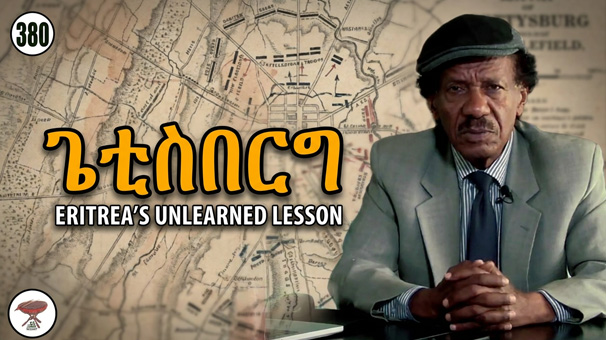
The Gettysburg Lesson Eritrea Never Learned
What separates genuine leadership from the exploitation of sacrifice? Using Abraham Lincoln's Gettysburg Address as a historical reference point, this essay examines the moral power of leadership during times of national crisis and contrasts it with Eritrea's post-independence experience. It explores freedom, citizenship, remembrance, national unity, and the responsibility owed to those who sacrificed their lives—not merely to honor their memory, but to build a better future for the living.

Oppressors and Oppressed
Enslaved and Enslavers
Lords and Commoners
Feudal Lords and Serfs
The world is wicked. No, it’s not wicked; some people, especially when they wield power, are wicked and brutal.
The American civil war (1861 to 1864), and the struggle for the emancipation of the blacks race is a worthy history for reflection…
I must mention an old saying by Khelifa Umar ibn al-Khattab: —Meta astaAbedtom annas weweledetehum umehatuhom Ahrara!
“Since when did you enslave the people when their mothers gave birth to them as free people?”

BREAK
The three-day Battle of Gettysburg was fought between 1 and 3 July, 1863. It was a decisive victory; the Union and the Confederate armies fought. It was the bloodiest war with 50,000 casualties. Dead, wounded, and missing.
In that battle, the Confederate army was defeated. Their goal to create a confederate state and establish an independent nation failed.
ABRAHAM LINCOLN
Abraham Lincoln delivered the famous Gettysburg Address, and later he was assassinated. The speech is still echoing in the minds of Americans.
A senator called Charles Sumner mentioned the Gettysburg Address when eulogizing the assassinated president and said Lincoln has said the following:
The world will take little note and will not remember it for long. But Senator Sumner said the world will never cease to remember the speech; the battle itself was less important than the speech.
The address was reproduced by many, and still the world remembers it. Here is a small part of the speech by Lincoln:
“Four score and seven years ago our fathers brought forth on this continent a new nation, conceived in liberty, and dedicated to the proposition that all men are created equal.”
Now think if there is any memorable speech given by Isaias Afwerki—and there are many clips of his speeches, interviews, and statements he made that Eritreans cringe at when they listen to. Do you remember any clean, positive, and hopeful speech worth mentioning?
Eritreans were engaged in a costly civil war, and it tested the nation. Was he dedicated enough to deliver a speech, resolute enough to unite the nation, or dedicated enough to bring about a bright future for Eritreans and to ameliorate their hardships?
He is neither wise enough to learn the lesson nor resolute enough to practically unite the nation.
But no one can question the rulers’ love for the battlefield; they are experienced and market every tragedy and flop and know how to take advantage of the sacrifices of Eritreans to the benefit of their party!
Eritreans are also infatuated by celebrations in memory of the martyrs, but they don’t show signs of will to stop more martyrdom. Why is Eritrea good at allocating and beautifying cemeteries and celebrations? The nation has buried enough martyrs! It must start celebrating the living, celebrating life, not death.
Would a martyr whose mother and family are suffering for lack of living space be content that he is buried in a tree-lined lush cemetery? But that doesn’t mean celebrations are totally useless. It shouldn’t be the main task of the nation.
Patriots sacrificed their lives for the good of the nation, for the good of the people spared, and had to live a life of mourning. It was never to secure a final resting place for them. But as a reminder for those who are buried in unknown ditches all over the region and beyond. They are so many.
A Good Speech Is a Moral Boost
Here’s an excerpt from Lincoln’s Gettysburg Address:
… in a larger sense, we can not dedicate — we can not consecrate — we can not hallow — this ground. The brave men, living and dead, who struggled here, have consecrated it, far above our poor power to add or detract. The world will little note, nor long remember what we say here, but it can never forget what they did here. It is for us the living, rather, to be dedicated here to the unfinished work which they who fought here have thus far so nobly advanced. It is rather for us to be here dedicated to the great task remaining before us — that from these honored dead we take increased devotion to that cause for which they gave the last full measure of devotion — that we here highly resolve that these dead shall not have died in vain — that this nation, under God, shall have a new birth of freedom — and that government of the people, by the people, for the people, shall not perish from the earth.
Abraham Lincoln, November 19, 1863
In the Battle of Gettysburg, the Unionists had a force of 93,921 soldiers commanded by General George G. Meade, while the Confederates had a force of 71,699 soldiers commanded by General Robert E. Lee. A total force composed of 165,620 soldiers was engaged in the fighting. In the three-day battle, as many as 51,000 soldiers from both armies were killed or wounded, and 5,425 were either captured or missing.
On April 9, 1865, General Robert E. Lee surrendered the largest number of the Confederate forces to the Union. The last battle of the civil war had to be fought—the Battle of Columbus, after Gettysburg, is considered the war’s final battle of the American Civil War.
Lincoln reasserted the purpose of the war in his historic Gettysburg Address:
The world will little note, nor long remember what we say here, but it can never forget what they did here. It is for us the living, rather, to be dedicated here to the unfinished work which they who fought here have thus far so nobly advanced.
What role did some enslaved workers play in the Battle of Gettysburg?
“Between 6,000 and 10,000 enslaved people supported Lee’s army as cooks, hospital attendants, blacksmiths, and personal servants to officers. Lee surely knew that some would desert him up north in Gettysburg. In January of that year, Lincoln had signed the Emancipation Proclamation, which gave enslaved people in the Confederate states their freedom. Despite this, many slaves remained loyal to their masters on the battlefield at Gettysburg and later accompanied them home or carried the effects of those who had died back to their families in the South. Others took advantage of the Union victory to break their bonds and join the opposition. Some Black camp workers were taken prisoner along with the Confederate soldiers at Gettysburg, and, once released, many stayed in the North.”
Eritreans went through many Eritrean Gettysburgs to unite their people, but Isaias is no Abraham Lincoln! He is rather the imitation of medieval Abyssinian warlords, whose logic of ruling is their concern for the land of the territories they lord over, not the rights of sovereignty of the people. True, land defines a nation, but not if there are no people in it. But to dictators, citizens are serfs whose sovereignty is in the abstract.
The Eritrean regime complains about the rampant injustices in the world, though the injustice it unleashes on Eritreans dwarfs the injustice in the rest of the beleaguered countries, but they are too callous to realize that.
Beleaguered people should not wait indefinitely for others to pity them; they must muster the courage and say, “Enough is enough.”
The Eritrean regime is defined by citizens who weigh citizenship lightly. They are typical examples of followers of abusive regimes who do not realize they are oppressed, but ironically, they aspire to oppress and discriminate against others.
Such is the governance that is damaging and hurting the Eritrean nation.
Related reading
1. Emancipation Proclamation
2. Gettysburg Address