
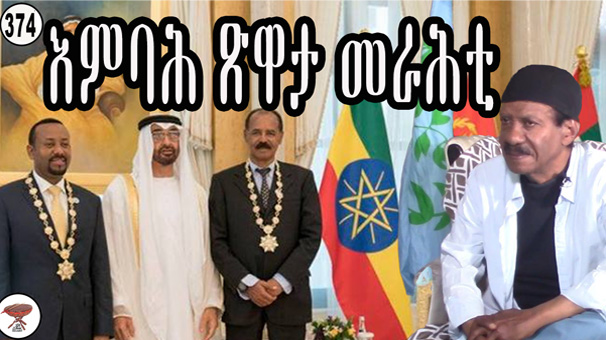

The current cycle of this familiar political game began in 2018, when Abiy Ahmed traveled to Asmara to meet Isaias Afwerki. The visit was presented as historic—a turning point not just for two states, but for two peoples long defined by conflict. Yet from the outset, the encounter carried a tone that was more personal than institutional.
Abiy was received in a setting that blurred the boundaries between state protocol and private hospitality. The symbolism was deliberate: a coffee ceremony where Minister Askalu served coffee and Aby passed bread and familial gestures and carefully staged interactions conveyed warmth and cultural familiarity. Abiy reciprocated with gestures meant to reflect humility and shared identity. These moments circulated widely, reinforcing the sense of reconciliation.
But beneath the imagery, there was little evidence of structured agreements or durable frameworks.
Narrative quickly filled that gap. Cultural figures amplified the message, portraying the moment as a cleansing break from the past—a future of unity, prosperity, and mutual respect. Optimism dominated public discourse. Wedi Tekhul, the well-known veteran singer, released an upbeat song.
Yet this optimism rested more on emotional resonance than on policy clarity. Core issues—border demarcation, political space, economic integration, and governance mechanisms—remained largely undefined.
When Isaias visited Addis Ababa, the performative dimension intensified. Public displays of closeness reinforced the impression of alignment. At one point, Isaias declared that Abiy would lead both Eritrea and Ethiopia, insisting he was serious: “From now on, Abiy will lead us, [Eritrea and Ethiopia]. Whether symbolic or not, the statement confirmed the deeper problem: political authority framed in personal rather than constitutional terms. The relationship was anchored in leadership rapport rather than institutional design. It depended on continuity of mood rather than clarity of structure.
Donate
The shift from peace to conflict came quickly. The war in Tigray marked a decisive rupture. What had been presented as a new era collapsed into large-scale violence. The consequences were severe: significant loss of life, widespread displacement, and deep economic strain. Resources that might have supported development were redirected toward sustaining conflict.
For those who had viewed Abiy as a break from Ethiopia’s past, the shift was stark. His early reformist image gave way to a wartime posture. Public messaging followed. The language of reconciliation receded, replaced by the language of control, reinforcing cults, and survival was under pressure.
One revealing moment came when Abiy asked a field commander about casualties and received the reply, “About 10,000.” The exchange underscored how quickly human cost becomes abstract in such contexts. Numbers replace lives; scale obscures reality.
Then the war trumpets pierced the air, “enewaga enewaga belew (Let’s fight, let’s fight!”
The Honeymoon Ended Quickly
The optimism that began in Asmara and was reinforced in Addis Ababa dissipated with notable speed. The alliance proved fragile because it lacked institutional grounding. It was sustained by leadership alignment, not by systems capable of enduring pressure.
This reflects a broader pattern in both countries. Political change is often driven by individuals rather than institutions. As a result, progress is difficult to consolidate. When conditions shift—whether due to internal pressures or regional dynamics—reversals follow.
War, in this context, is not simply a breakdown of politics; it often becomes an extension of it. Mobilization consolidates authority. Conflict reinforces control. This does not make war inevitable, but it helps explain its recurrence.
Abiy’s trajectory illustrates this duality. A Nobel Peace Prize laureate, prematurely recognized for facilitating dialogue, later presided over a major war. Maybe he thought he also deserved a Nobel Prize for war.
Disappointed by his people, he bitterly told his parliament, “Leading Ethiopians is like carrying a million ants.” If ants are crushed, no one sheds tears for them!
This contrast is not purely personal—it reflects the structural environment in which leadership operates.
Public rhetoric also evolved. Appeals to unity increasingly emphasized strength rather than inclusion. At times, descriptions of leadership challenges framed the population in ways that diminished individual agency. Such language signals a hierarchical conception of governance.
At the societal level, mobilization followed familiar patterns. Messaging, music, and public discourse aligned with state narratives. Participation ranged from genuine support to constrained compliance. The result is a public sphere where consensus often reflects pressure as much as conviction.
Military-speak
As alignment between Abiy and Isaias deepened, their rhetorical styles showed increasing convergence. Security concerns became central. Political opposition was framed less as competition and more as a threat. While electoral language remained, the practical space for contestation narrowed.
In Eritrea, this model is longstanding. The fusion of party and state centralizes authority and limits accountability. Official narratives emphasize unity and resilience, often sidelining internal challenges. Following the independence of Eritrea, Isaias declared, “To me, the PFDJ is not a party; it’s the nation.” And that has become his trademark style of diplomacy.
The consequences are visible in everyday life. Access to basic services remains inconsistent in many areas. Yet public communication tends to focus on external pressures rather than internal solutions. When grievances are raised, responses often emphasize endurance rather than reform.
Crude Attitude Doesn’t Attract Investors
Economic governance reflects similar constraints. Sustainable investment depends on predictability, transparency, and rule-based systems. Where decision-making appears arbitrary, risk perceptions increase. Public messaging that downplays structured economic planning reinforces uncertainty.
In Eritrea, economic policy is closely tied to political priorities. In Ethiopia, despite a more diversified base, conflict has introduced instability that affects investor confidence. Visible initiatives—urban development and tourism promotion—do not fully address underlying structural challenges.
Accountability remains limited. Policy outcomes are rarely subjected to open evaluation. Instead, narratives are adjusted to maintain coherence with leadership messaging. This restricts institutional learning and perpetuates inefficiency.
When he faced a citizen’s complaint about shortage of drinking water, his response was both typical and trivial: “Who owns water, who owns air…”
Work Without Pay
Labor dynamics provide a stark illustration of systemic contradictions. In Eritrea, national service has evolved into a prolonged obligation, prompting many to leave the country in search of alternatives. Enforcement mechanisms underscore the limited choices available. Does Isaias disapprove of work without pay? He confuses the people who genuinely complain, stating he is not willing “to work without pay.”
In Ethiopia, economic disruption has reduced opportunities and increased precarity. While the contexts differ, the outcome is similar: citizens operate within constrained systems where economic participation is shaped as much by political conditions as by market forces.
And this is his type of shutting out investors: “Do you have dollars? Do you have euros? Where did you get them from?”
That kind of leadership is his typical blubber; it’s Isaias’ diplomacy 101.
Religion, Society, and Silence
Religious institutions occupy a complex position. In principle, they could serve as moral anchors. In practice, their engagement with political authority is uneven. Some avoid confrontation; others contribute—intentionally or not—to the spread of questionable claims.
This weakens their potential role in guiding public ethics. The broader information environment reflects this gap. Misconceptions persist when they are not consistently challenged. Education systems, operating under similar constraints, struggle to correct them.
The Competition
The relationship between Ethiopia and Eritrea now reflects a form of competitive alignment. Cooperation coexists with suspicion. Accusations of interference, displays of military readiness, and assertive rhetoric create a persistent sense of instability.
Media ecosystems amplify these dynamics. Narratives often escalate in response to leadership signals, reinforcing tension. War becomes a recurring possibility rather than a distant risk.
Alternative voices exist—academics, analysts, and civic actors—but their influence remains limited. Structural constraints restrict their reach.
At times, leadership competition extends into ambitious declarations that outpace practical capacity. These statements function more as signals of intent than as actionable plans, reinforcing the gap between rhetoric and reality.
Abiy and Isaias are like “Dr. Jekyll and Mr. Hyde,” playing each other’s alter egos and competing on who wins the absurdity award. Their rationale and attitudes are naturally aligned.
Every now and then Abiy throws a surprise: ‘With 139 million people, we need Nuclear energy…of course for peaceful purposes.’
Conclusion
The Ethio-Eritrean political dynamic follows a recognizable cycle: optimism driven by leadership initiative, followed by fragmentation and renewed tension. The pattern persists because it is not anchored in institutions capable of sustaining change.
The consequences fall primarily on ordinary citizens. Without systems that ensure accountability, distribute authority, and enable genuine participation, the cycle is likely to continue.
Breaking it requires more than agreements between leaders. It requires structural reform—institutions that outlast individuals, governance that prioritizes transparency, and a public sphere that allows meaningful debate. Until then, the “peekaboo” pattern remains, moments of promise followed by reversal, visibility followed by retreat.