
The Pledged Public: Toward an answer to “The Grammar of Promise”

“The problem is not to find the best ruler. The problem is to make it impossible for a ruler, however well-intentioned, to do unlimited harm.” — Karl Popper, The Open Society and Its Enemies
Summary
This essay continues the argument of “The Grammar of Promise,” which showed that Eritrean political culture organizes legitimacy around sacrifice and moral debt, making structural critique unavailable and structural solutions unthinkable. That essay ended by gesturing toward an alternative: organizing political agreement around conditions rather than around persons. This essay asks what organizational form could actually hold that alternative in the political realm. The answer is not a coalition, a transitional government, a national dialogue, or a protest movement. It is a civic structure called the Pledged Public, in which citizens commit to each other, before any authority takes power, around minimum conditions that any future government must satisfy before receiving recognition. The central innovation is conditional recognition: not a promise from above, but a pledge among citizens that withholds legitimacy until specific structural thresholds are met. The essay argues that this reversal is the break that the grammar of promise has, until now, made impossible. It also acknowledges that the reversal remains conceptually incomplete, practically uncertain, and historically untested.
The Grammar and What It Produces
The preceding essay argued that Eritrean political culture operates according to something it called the grammar of promise: an underlying set of rules that determines which political claims feel intelligible, which critiques feel available, and which solutions feel thinkable, largely below the threshold of deliberate reflection. It is worth restating that argument briefly here, not because it needs defending again, but because everything in this essay depends on holding it clearly in mind.
The liberation struggle produced more than a state. It produced a specific way of understanding what political authority is and where it comes from. A generation sacrificed enormously. When independence arrived, it arrived as the redemption of a moral debt, and the movement that led the struggle arrived at power not through elections or constitutional procedure but through that sacrifice, which in Eritrean political culture functions as a form of legitimacy that no procedural mechanism can easily match or challenge. The implicit contract was a promise: we died for you, and those of us who survived will now build for you. The public’s role in this arrangement was to receive the promise and to extend trust.
What follows from this, structurally, is a specific form of political vulnerability. If legitimacy flows from the sincerity of those who invoke sacrifice, then the only critique of power that the grammar makes available is a moral one. The charge against those who govern badly is not that the structure of authority made institutional accountability unavailable, not that any similarly positioned actor would have faced the same temptations and the same absence of constraint. The charge is that they betrayed the sacrifice. And a moral charge points toward a moral solution: more sincere promise-keepers, leaders with a more genuine lineage of commitment, a new generation prepared to honor what the old one failed to honor. The structural question, of what kind of authority arrangement made the outcome not just possible but predictable, tends not to get asked. It does not fit the grammar.
Donate
The cycle that follows is not, then, a sign of moral failure or political immaturity. It is the grammar working as grammars do, invisibly and reliably, organizing what can be thought and what cannot. A movement organizes around a moral project. It achieves its goal. It governs through promise, unconstrained by any independent mechanism capable of holding it to account. The promise collapses. The collapse is diagnosed as betrayal. A new moral project organizes in response, carrying the same grammatical assumption: the problem was the people, not the structure. Find better people. The sequence begins again.
What is perhaps most striking, and most worth dwelling on, is that this grammar operates with equal force inside the opposition. The familiar argument for diaspora political unity follows a logic that feels like pragmatism: the opposition is fragmented, a unified coalition is needed, factional differences are secondary, and unite to overthrow and negotiate the rest afterward. But seen from inside the grammar, this is not pragmatism at all. If legitimacy derives from fidelity to sacrifice and from the promise of honoring what the martyrs died for, then removing those who betrayed the promise is itself a moral obligation. The coalition around overthrow is not a minimal, practical agreement. It is grammar’s own inevitable conclusion. And the morning after the regime falls, the shared purpose has been fulfilled. What remains is a competition over who defines what comes next, with the same unconstrained authority and the same absence of structural accountability that produced the problem in the first place.
Why Charters Do Not Break the Cycle
The most important and perhaps most uncomfortable implication of the grammar of promise analysis is that previous constitutional moments, previous charters, and many of the frameworks being proposed today, have not and cannot interrupt the cycle on their own. It is worth being direct about this, even though it means applying the analysis to documents produced with genuine aspiration and sometimes considerable sacrifice.
The National Charter of 1994, the constitutional ratification of 1997, and the various opposition charter proposals that have followed: each of these operated as a promise made by a governing or would-be governing authority, awaiting future implementation, requiring trust before any enforcement capacity existed. The 1994 Charter articulated principles of democratic governance that read, even now, as serious and thoughtful commitments. It produced nothing institutionally, not because its authors were necessarily insincere, but because the public had not been organized to demand its implementation. The document existed. The charter existed. The civic force capable of treating the charter as a contract, rather than as a gift, did not. And gifts, in politics, can be taken back whenever the giver decides they are inconvenient.
The same pattern runs through opposition platforms. When organized opposition groups produce charters, those charters still function as promises: this is what we will do if we come to power; trust us to implement it; extend us your recognition now in anticipation of accountability later. The charter belongs to the coalition. Its authority derives from the credibility of the organization that produced it, not from a civic process through which a broad and diverse public has genuinely deliberated and committed. The public is still being asked to extend recognition in advance of conditions. The direction of political obligation has not changed.
This is precisely what the charter at the center of the Pledged Public is not, or at least what it attempts not to be. Whether it can succeed in being different is a real question, one that only the practice of building it can answer. But the conceptual intention is clear: the charter is not a governing blueprint offered by a would-be authority to a waiting public. It is a citizen-to-citizen instrument, a framework through which the public itself determines the conditions under which it will recognize any authority at all and commits to withholding recognition from those who fail to meet them. The charter does not tell a future government what vision to pursue. It tells any future government what it must accept before the public organized around these conditions will treat it as legitimate. The distinction between a charter as a governing promise and a charter as a public legitimacy condition is the conceptual hinge on which everything else turns.
The Zero Moment and Why It Has Always Been Captured
Every political transition has a moment that might be called the zero moment: the power vacuum that opens when old authority collapses and new authority has not yet established itself. It is the hours and days during which institutions are at their weakest, armed actors move fastest, and the question of who governs is settled not by deliberation but by organizational speed and readiness. Eritreans have reason to fear this moment. They have seen it before.
In 1991, the vacuum lasted days. The EPLF filled it so completely and so quickly that by the time anyone might have asked what conditions the incoming authority would accept, the question had already been answered by the fact of organizational supremacy. The transition was not negotiated. It was captured. And what was captured in that brief interval has governed the country for more than three decades. The fear that generates in Eritrean political discourse is not irrational or merely psychological. It is grounded in direct experience of what happens when a power vacuum meets an unprepared public.
The anxiety the zero moment produces is specific: whoever moves fastest fills the vacuum, and whoever moves fastest tends to be the most organizationally capable armed actor. The transition seems to belong to force rather than to civic aspiration. Whatever agreements, charters, or platforms the diaspora has spent years producing seem, in that moment, irrelevant to what is actually being decided.
This fear, though, rests on a hidden assumption that deserves examination: the assumption that the vacuum can only be filled during the crisis, by whoever acts first when it erupts. Remove that assumption, and the zero moment looks different. A vacuum does not need to be filled during the crisis if the public has already, before the crisis, organized its civic power and determined what it will and will not recognize. An incoming authority that faces a prior public, one that has deliberated and pledged and arrived at a known framework of conditions, does not enter an empty space. It enters a structure. It cannot proceed on the same terms that the EPLF proceeded on in 1991, because those terms depended on an absence that has now been partially filled.
This is what the Pledged Public attempts to create. Whether it can succeed, whether the civic commitment built in advance can hold under the pressure of an actual transition, and whether the forms of recognition withholding can be coordinated quickly enough to matter are genuinely open questions. The concept does not answer them. It argues only that the alternative, arriving at the zero moment without any of this in place, has already been tried. We know what it produces.
What the Pledged Public Attempts to Be
It is tempting and probably unavoidable to try to understand the Pledged Public by assimilating it to something familiar. It looks, from certain angles, like an opposition coalition. To others, it looks like a civil society movement, or a transitional proposal, or a platform for regime change activism. These resemblances are real enough to be worth examining directly, because the Pledged Public’s distinctiveness, if it has any, lies precisely in what it is trying not to be.
It is not another coalition. Coalitions organize to contest power, project credible succession, and compete for the position of governing authority. The pledged public does not seek governing authority. It organizes the conditions under which governing authority may be recognized, which is a different activity at a different political level.
It is not a protest movement or a civil resistance campaign. Those frameworks, however valuable in other respects, still typically revolve around capturing, replacing, or pressuring an existing government. Their goal is a change of rulers. The Pledged Public is not organized against any particular government. It is organized around the prior question of what any government must accept before the public will recognize it at all.
It is not a transitional government proposal. Such proposals describe what an authority would do after it has already assumed power. They are blueprints for the promise. The Pledged Public sets the conditions that any authority must satisfy before recognition is extended.
And it is not a revolutionary front. Revolutionary fronts seek to capture the state. The Pledged Public seeks to condition the terms on which any state receives civic legitimacy.
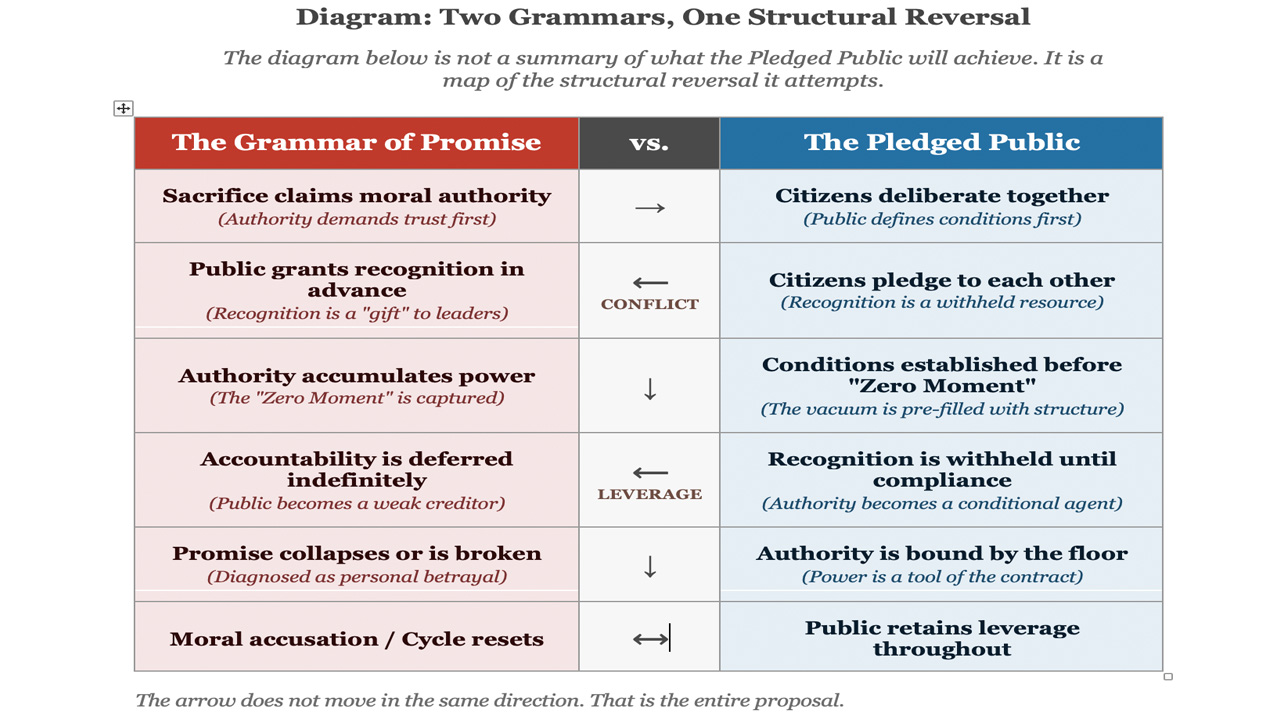
The conceptual core of the difference is a reversal of direction. Under the grammar of promise, organizations ask the public for recognition first and promise future accountability later. The public extends trust in advance of conditions. Recognition precedes enforcement. Under the Pledged Public, citizens pledge to each other first and withhold recognition from any authority that does not satisfy conditions the public has set in advance. The public does not wait. Recognition is conditional from the outset.
This is a peer-to-peer citizen structure. Its organizing question is not who should govern Eritrea but what conditions must any governing authority satisfy before the public organized around these conditions will recognize it. Members do not join because they share a vision of the ideal Eritrean state. They may disagree profoundly about federalism, economic organization, the role of religion in public life, and dozens of other substantive questions. They join because they agree that any future authority must satisfy certain structural minimums before receiving their collective recognition and because they commit to stand with each other around those minimums when the transition moment arrives. Whether they can actually hold that commitment, whether the pledge survives contact with the pressures of a real transition, is not something this essay can guarantee. It is the hardest and most important question the framework raises, and it belongs not to the theorist but to the people who would try to build it.
The Public Already Holds the Power
One of the things worth pausing on is where political power actually sits under each of these two arrangements.
Under the grammar of promise, the public is politically weak while waiting. It has extended recognition in advance. It holds no enforcement capacity. Its only instrument afterward is moral pressure: the accusation of betrayal, the invocation of the martyrs, and the demand for fidelity to a promise already granted. This is the position of a creditor who has delivered without collateral, who has, in the act of extending credit, surrendered the only leverage available.
Under the Pledged Public, recognition has not been extended. It is being withheld, pending conditions. The public holds it. Not comfortably, not without difficulty, and not without the risk that its collective commitment will fracture under pressure. But it holds it. The leverage exists before any transition occurs, because any incoming authority must already know, before it makes its first move, that civic recognition will be conditional. The pledge itself is where the power resides, not in what the public will do after disappointment but in what it has already committed to requiring before granting recognition at all.
This is a different location for political power than the grammar of progress has ever produced. The public is not waiting to be delivered. It is holding the terms of delivery. Whether it can hold them is another matter. But at least the architecture points the leverage in the right direction.
The Conditions Charter: Starting Point, Not Decree
The Pledged Public is organized around a conditions charter. The status of that charter needs to be stated carefully, because misreading it would misread the entire organizational form.
The charter is not a finished document produced by theorists and handed to the public for endorsement. It is a starting point for deliberation: proposals of what minimum thresholds should look like, offered to communities, professional associations, religious bodies, and civic groups for examination, argument, refinement, replacement, or expansion. The specific conditions that emerge from this process may differ considerably from the ones that initiated it. Some may be reformulated. Others added. What cannot change is the deliberative character of the process that produces them, because that process is what gives the resulting conditions their civic authority rather than their merely theoretical interest. A charter handed down from an organization to a waiting public is another form of promise. A charter produced through genuine deliberation and owned by the public that deliberated it, is something closer to civic sovereignty.
The conditions that such a process is likely to produce are not difficult to anticipate in broad outline. The release of political prisoners. Freedom of association and independent media. A binding time limit on transitional authority. Independent civic oversight. Non-domination of politics by armed organizations. An open constitutional process. A prior commitment to electoral compliance. These are the structural minimums without which democratic participation cannot meaningfully occur. They are not a vision of what Eritrea should become. They are the floor below which any transitional arrangement fails to create the conditions for democratic life to begin.
People who have genuinely worked through these conditions, who understand why each one addresses a specific structural failure that Eritrean political history has documented, and who have committed from that understanding rather than from deference to an elite document, will hold the commitment differently than those who merely signed. This is not a small distinction. The depth of deliberative ownership is probably the single most important variable in whether the Pledged Public can function at all.
Why This Reduces Fragmentation
One of the recurring failures of Eritrean opposition politics is fragmentation: coalitions that form, subdivide, and recombine around questions of leadership, representation, and ideology, producing no sustained civic force capable of acting at a decisive moment. The Pledged Public’s architecture is designed to address this, though not by wishing ideological disagreement away.
The argument is not that the Pledged Public produces consensus. It does not. Eritreans will continue to disagree about federalism, economic organization, the role of religion in public life, regional representation, and the meaning of liberation itself. The Pledged Public takes no position on these disagreements, which is precisely the point.
The argument is structural: the pledge framework creates incentives for convergence around minimally necessary shared conditions because numbers are political leverage. Isolated groups that hold compatible conditions but refuse to coordinate around them weaken their own capacity to enforce those conditions. Fragmentation reduces the credibility of the withholding. An incoming authority that faces twenty small, uncoordinated civic voices expressing disappointment can absorb that. An incoming authority that faces a coordinated public of sufficient breadth, committed in advance to a known and specific framework of conditions, faces something harder to dismiss.
Previous Eritrean coalitions struggled because trust deficits dominated: groups feared that joining a coalition meant surrendering their political positions and representational claims before any guarantees existed, before any structural protection against being absorbed or overridden. The pledge framework is structurally different. Members do not surrender their political views to a coalition. They commit to a minimum conditions framework alongside others who have made the same commitment. Their own positions remain intact. They have not transferred legitimacy to leadership. They have coordinated around a floor. The convergence is incentivized by the logic of collective leverage, not produced by trust in particular persons. Whether that incentive is strong enough to overcome the specific trust deficits and historical grievances of Eritrean political life is, again, a genuinely open question.
Latency Is Part of the Power
One of the less obvious features of the Pledged Public, but perhaps one of the most practically important, is that it derives power partly from latency. Its force may exist before open activation. People can commit privately. Participation can accumulate beneath visible political organization, across professional networks, religious communities, family connections, and diaspora circles without requiring the kind of public identification that repressive conditions make dangerous or impossible.
This is not passivity. It is stored readiness, and it is specifically designed for conditions in which open political organization is unavailable. Inside Eritrea, where political activity carries severe risks, a person who has encountered the conditions framework, found it compelling, and privately committed to act on it at the transition moment is a genuine member of the Pledged Public in everything that matters. The commitment is real. Its organizational trace is invisible. Its political consequence becomes visible only when the zero moment activates it.
An incoming authority cannot suppress what it cannot see. It cannot arrest a commitment. The latent, pledged public is not a structural weakness. It is an organizational design suited to conditions in which any visible structure would be immediately vulnerable. And it means that the public’s power can be cumulative and growing even during years when its growth is entirely invisible from outside.
The Mechanics of Withholding
What does withholding recognition actually look like in practice? This question deserves honest engagement rather than rhetorical confidence. The answer is that the forms vary considerably by context, by the scale of the pledged public at the moment of activation, and by the specific political situation the transition produces.
In the diaspora, where organization is possible, withholding recognition means organized declarations of non-recognition from professional associations, religious communities, and civic networks; signature campaigns that can be presented to foreign governments and international bodies as evidence of an organized civic position rather than scattered individual protest; the withdrawal of diaspora institutional endorsement from any transitional authority that has not met conditions; and sustained advocacy in the international arenas where transitional legitimacy is also negotiated, often before domestic legitimacy is fully settled. Inside Eritrea, where religious institutions carry the deepest social authority, it means the posture of the Orthodox Church, the Catholic Church, and Muslim institutions toward the incoming authority: whether they participate in transitional ceremonies, whether they offer legitimation to transitional proclamations, or whether they call on their communities to cooperate or to withhold. These are not symbolic gestures. They are determinations of whether an authority can claim to govern a society whose daily civic life runs through those institutions.
The terms governing this withholding need to satisfy two requirements, and they are not easy to satisfy simultaneously. The first is precision: conditions must be specific enough that their satisfaction or violation can be determined without reference to the intentions of the authority being evaluated. The release of political prisoners is a precise condition. Whether an authority has honored the sacrifice is not. The second is democratic coherence: the withholding of recognition must remain oriented toward creating the space for democratic participation rather than simply opposing whoever holds power. It must be graduated and conditional, responsive to partial compliance as well as complete refusal, because an authority that can credibly say the pledged public refuses recognition regardless of what it does has a legitimate counter-narrative. The goal throughout must be compliance, not a permanent standoff.
How exactly these two requirements are held together in practice, under the pressure of an actual transition, is one of the genuinely unresolved questions at the heart of this proposal.
What Remains Unresolved
It would be dishonest to present this framework as more complete than it is.
The Pledged Public is a conceptual proposal, and many of the most important practical questions remain genuinely open. How exactly are pledges verified and communicated across a dispersed network operating under difficult conditions? What mechanisms ensure that those who commit actually activate when the moment arrives, rather than calculating that their individual withdrawal will not be noticed? How does the conditions charter evolve through deliberation without fracturing around the same representational disputes that have undone previous coalitions? How does the framework maintain coherence across the sharp difference in organizational conditions between the diaspora and inside Eritrea? How is the graduated withholding of recognition actually coordinated in the chaotic early days of a transition when speed matters and communication is uncertain?
These are not rhetorical questions. They are genuine structural difficulties that any attempt to build the pledged public will have to confront and that this essay cannot resolve in advance. The concept does not arrive with an operational manual.
The more modest claim being made is this: the conceptual diagnosis may be correct, and if it is correct, then producing better promise-makers, more sincere coalitions, or more sophisticated transitional blueprints will not interrupt the cycle. Something structurally different is needed, something that changes where political power sits before a transition rather than after it. Whether the Pledged Public is the right form of that structural difference is a question that belongs to the deliberative process itself, to the Eritreans who would deliberate, refine, own, and ultimately hold or abandon the pledge. The essay can point toward the problem with reasonable confidence. It cannot guarantee the solution.
A Different Relationship Between the Public and Power
There may be no exact historical corollary for this form of civic organization in Eritrean political history, and perhaps not beyond Eritrea in precisely this form. It is not solidarity, which was a mass labor movement with explicit political ambitions. It is not the Freedom Charter movement, which was embedded in an organization seeking state power. It is not civil society in the conventional sense, which assumes a functioning political framework and works to hold it accountable from within. It is an attempt, necessarily incomplete, to imagine a different relationship between public legitimacy and political authority: one in which the public holds legitimacy as a conditional resource rather than granting it in advance, in which recognition is a structure of civic power rather than a gift extended toward those who claim to serve.
Whether that attempt can succeed, whether it can translate from conceptual architecture into lived civic commitment capable of surviving contact with an actual transition, is not something this essay can settle. It can only argue that the grammar of promise has organized Eritrean political life for as long as the nation’s modern political form has existed, that it has produced extraordinary sacrifice and genuine collective achievement; and that it has also produced the cycle that those who sacrificed most were trying to end. That cycle will not be interrupted by another moral project or another sincere coalition operating by the same underlying rules. It requires different grammar.
Under the grammar of promise, organizations ask the public for recognition first and promise future accountability later. The public waits. Trust is the currency. And when the trust is betrayed, the only available response is moral: a new accusation of betrayal, a new search for authentic promise-keepers, a new beginning of the same cycle.
The Pledged Public attempts to reverse the direction. Citizens commit to each other first. Recognition is extended to any authority that meets the conditions and withheld from any authority that does not. The charter is not a promise made toward the public. It is a pledge made among citizens around the conditions under which they will consent to be governed.
That reversal is the conceptual intervention this essay is proposing. Whether it is achievable and what it would actually take to achieve it are questions that only the practice of building it can answer. But the zero moment will come again. What fills it will depend, at least in part, on what was organized before it arrived.
That public does not make a promise. It holds a pledge. The difference is everything.
Author contact: filmon.tesfai33@gmail.com
Works Consulted
- Arendt, Hannah. On Revolution. New York: Viking Press, 1963.
- Connell, Dan. Against All Odds: A Chronicle of the Eritrean Revolution. Trenton, NJ: Red Sea Press, 1993.
- Eritrean People’s Liberation Front / People’s Front for Democracy and Justice. National Charter of Eritrea. Nakfa: Third Congress of the EPLF/PFDJ, 1994.
- Government of Eritrea. The Constitution of Eritrea. Asmara, 1997.
- Habermas, Jürgen. The Structural Transformation of the Public Sphere: An Inquiry into a Category of Bourgeois Society. Translated by Thomas Burger. Cambridge, MA: MIT Press, 1989.
- Kibreab, Gaim. Eritrea: A Dream Deferred. Oxford: James Currey, 2009.
- Linz, Juan J., and Alfred Stepan. Problems of Democratic Transition and Consolidation: Southern Europe, South America, and Post-Communist Europe. Baltimore: Johns Hopkins University Press, 1996.
- O’Donnell, Guillermo, and Philippe C. Schmitter. Transitions from Authoritarian Rule: Tentative Conclusions about Uncertain Democracies. Baltimore: Johns Hopkins University Press, 1986.
- Popper, Karl. The Open Society and Its Enemies. London: Routledge, 1945.
- Sharp, Gene. From Dictatorship to Democracy: A Conceptual Framework for Liberation. Boston: The Albert Einstein Institution, 1994.