
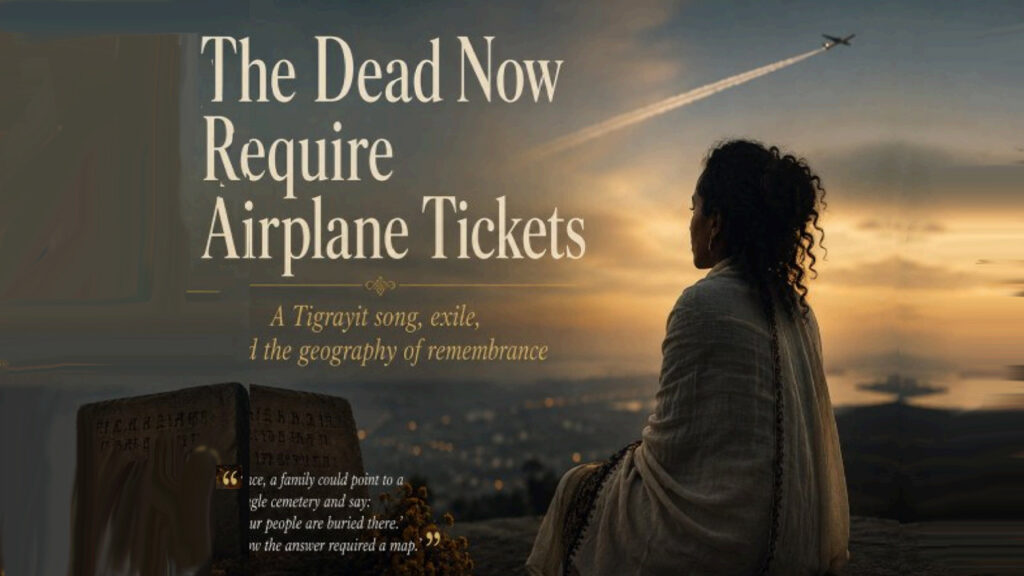

A Tigrayit song, exile, and the geography of remembrance. The song found me on an ordinary evening.
Outside my apartment window, traffic moved through the city in long ribbons of light. Somewhere below, a siren sounded and disappeared. Tomorrow will be another workday. I would return to my carefully constructed routines. Nothing about the evening suggested that a song could interrupt it. Yet it did.
A voice singing in Tigrayit emerged from my phone and settled somewhere deep inside me. The melody was familiar, though I could not say why. It was not a song I had grown up hearing every day. Nor was it attached to a particular memory. Still, after it ended, something remained. Days later I found myself returning to it. Then returning again.
The song seemed less interested in entertaining me than in accompanying me. It followed me through ordinary tasks. Through grocery stores and parking lots. Through lecture notes and unfinished emails. I began to wonder why. At first, I blamed nostalgia. That seemed reasonable.
People who leave one country and build a life in another are often accused of living in nostalgia. We are told that memory softens reality, that distance edits history, that longing transforms imperfect places into imagined paradises. Perhaps that is the case. But the more I listened, the less convinced I became.
Nostalgia suggests a desire to return. Return where? Return to what? The place I left no longer exists in the form I remember it. The streets have changed. The people have changed. The nation has changed. Even the child who once inhabited that landscape has changed. Some losses cannot be reversed. Some journeys move only in one direction. The past survives only as memory.

For years, I resisted that idea. It felt too final. Too merciless. Yet sitting with the song, I began to understand that certain homes survive only within us. Time moves on. Places change. People disappear. Entire worlds recede beyond our reach. But that was not the whole story. Because life continued.
I went to school. I studied. I learned new languages. I crossed borders. I built a profession. I built friendships. I built a life. If exile destroyed one home, it also forced me to construct another. The song seemed to understand this contradiction. It mourned what had been lost without denying what had been gained. That must be why it would not leave me alone.
One evening, listening again, I found myself thinking not about the living but about the dead. The thought arrived unexpectedly. When I was young, families knew where their dead were buried. Generations rested together. Grandparents beside grandparents. Aunts beside uncles. Parents beside parents. The living visited, prayed, and remembered. The geography of remembrance was simple.
Then came exile. Not mine alone. Ours. Years passed. A relative buried in one country. A family friend in another. Someone’s mother elsewhere. Someone’s father somewhere farther still. The map kept expanding. Africa, Europe, North America, the Middle East, Australia, etc. The names accumulated like pins on a globe. At some point I realized something that startled me.
The dead had followed the living into exile. For years I had thought exile belonged to the living. Then I began noticing where the dead were buried. And suddenly the entire story looked different. The tragedy was not simply that people had left. The tragedy was that history had scattered even their final resting places. Once, a family could point to a single cemetery and say, “Our people are buried there.” Now the answer required a map. I sat with that thought for a long time.
The dead now require airplane tickets. The sentence arrived uninvited. I could not shake it. To visit one grave requires crossing an ocean. To visit another requires crossing a continent. To visit a third required another passport. The family cemetery had become the world itself. The older I became, the more I realized that the song was not speaking only to me. It was speaking to a generation. To those who left. To those who stayed. To those who imagined returning and discovered that time had quietly altered both the place left behind and the people who carried it in memory.
The melody seemed to understand something many of us struggle to articulate: exile does not end when one acquires citizenship, purchases a home, or builds a career. Exile changes shape. It settles into memory. It appears unexpectedly in conversations, photographs, funerals, and songs. Yet even then the song refused despair.
Because the same story that produced scattered graves also produced new lives. Children born in countries their grandparents never imagined. New languages spoken around dinner tables. New professions. New friendships. New identities. The house may have changed beyond recognition. But people carried pieces of it with them. In stories. In recipes. In names. In songs. The melody ended.
Outside, the traffic continued moving through the city. Tomorrow I would return to work and continue the life I had built. Yet for a few minutes I remained still. Not because I wished to return. Not because I believed the past could be recovered. But because I finally understood that some journeys never truly end. They simply learn new languages. The song had not asked me to go back. It had asked me to remember. And somewhere between memory and becoming, between loss and survival, I discovered that exile is not the opposite of home. It is what happens when home continues traveling inside you long after you have left.