

The Citizen Before the Bloc: A Critique of Younis Omer’s Politics of Equilibrium
I come to this discussion with humility. I am still a newcomer to the Awate forum, and I…
Dr. Filmon Wolde13 min read

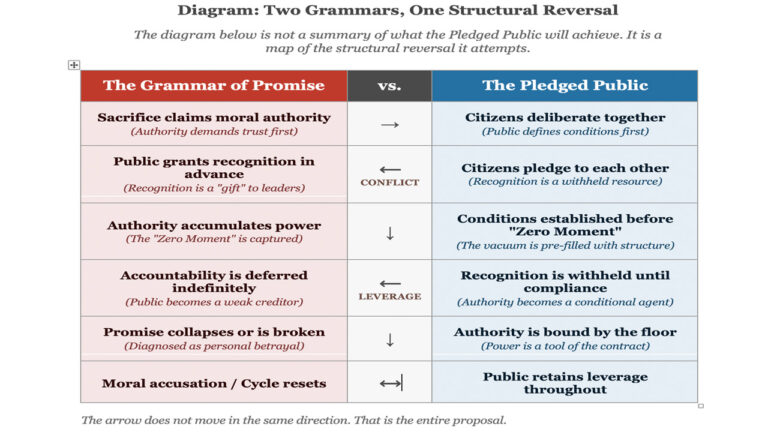
This essay explores the idea of a prepared and pledged public: a public that understands its power, accepts responsibility, and is prepared to act rather than simply be acted upon.
Dr. Filmon Wolde22 min read
Dr. Filmon Wolde15 min read
Dr. Filmon Wolde11 min read
Dr. Filmon Wolde28 min read
Dr. Filmon Wolde13 min read
I come to this discussion with humility. I am still a newcomer to the Awate forum, and I…
Dr. Filmon Wolde13 min read
Abstract: This essay examines how the Eritrean state converted the moral authority of the armed struggle into a…
Dr. Filmon Wolde8 min read
I recently came across a song by Meron Estifanos, freshly uploaded to YouTube and already making its way…
Dr. Filmon Wolde13 min read
A Second Explanation for Readers Who Want the Mechanism, Not Just the Idea The public is not the…
Dr. Filmon Wolde17 min read
“The problem is not to find the best ruler. The problem is to make it impossible for a…
Dr. Filmon Wolde24 min read
“The most dangerous moment for a bad government is when it begins to reform.” – Alexis de Tocqueville…
Dr. Filmon Wolde18 min read
“Once deprivation is renamed ‘culture,’ it becomes protected from criticism. What appears as heritage can quietly function as…
Dr. Filmon Wolde9 min read
Author’s note: In this piece, I’m more interested in the subtle visual habits that quietly reorganize authority and…
Dr. Filmon Wolde8 min read
Author’s Note This essay examines a recurring pattern in Tigray’s post-war political culture: the public’s tendency to celebrate…
Dr. Filmon Wolde10 min read
Author’s Note: This essay is written in response to a document recently shared by Bereket Habtemariam on his…
Dr. Filmon Wolde9 min read
Author’s Note: This essay is not a tactical critique of government or opposition, but an attempt to reframe…
Dr. Filmon Wolde6 min read
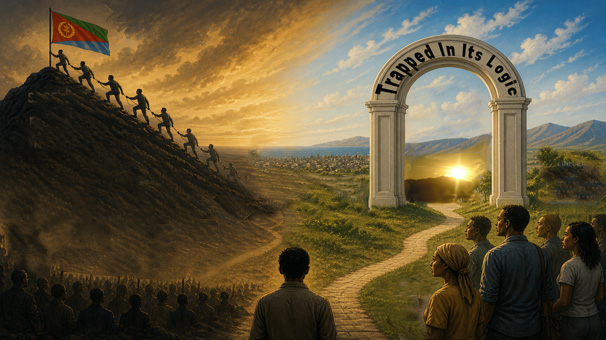
Author’s Note: This short essay is written as a reflection on Eritrea’s independence narrative and the moral contradictions…
Dr. Filmon Wolde9 min read
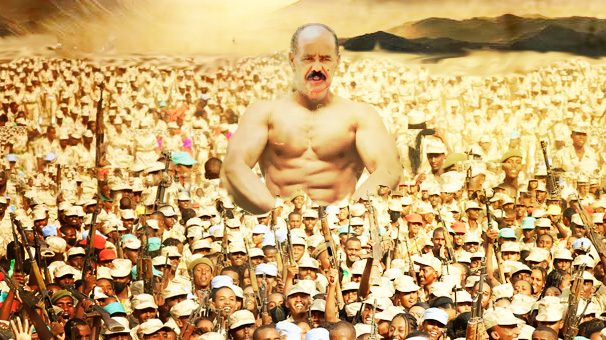
“The myth of Eritrean self-reliance… has helped justify authoritarianism, isolation, and indefinite national service.”
Dr. Filmon Wolde8 min read