
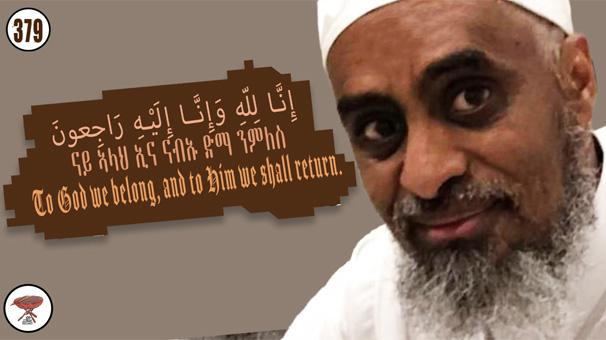

Last week, we lost an exemplary and peaceful person endowed with a kind heart and a beautiful soul. He was reconciled with all that life gives and takes, both from himself and from others. He lived a spiritually and physically content life. But like every creature, his time was up, and after a long struggle with his health, he quietly departed.
I am talking about a brother whose calmness and contentment were exemplary. I wish there were a way to distill the essence of such a spiritually rich person and distribute it to many people. One drop of that elixir could have worked wonders.
The name Kebire is uncommon. It is so rare that only a small group of people name their children Kebire.
In the 1990s, Kebire visited us. My son was only a child, and I introduced him, saying, “Meet Uncle Kebire.”
Early the next morning, Kebire came by, and my son woke me up.

“Wake up, Papa, Uncle Camera is here!”
It was Kebire. I corrected him, “Uncle Kebire, not Uncle Camera.”
For some reason, he had difficulty pronouncing Kebire, and for a long time afterward, he remained “Uncle Camera.”
Dr. Kebire Abdulrahman Ahmed Younis has left us—may his soul be received by the mercy of the Almighty.
Kebire went to school in Eritrea and Sudan. He stayed briefly in Egypt. In the 1980s, he migrated to the United States, where he completed his PhD.
He is survived by his wife, two sons, a daughter, numerous brothers and sisters, countless close and distant family members, and friends—as well as many people whose lives he touched through his quiet and unannounced charitable work. He was well known in many circles. Too many people to mention individually. He lived a full life and built a wide network of relationships with people from all over the world.
Dr. Kebire was buried in Houston, where his mother, my aunt, was buried some years ago.
I read many eulogies posted by his friends, schoolmates, and others. It took me longer to come out and write this. Such sad events take time to sink in, and for a while, I never fully accept them.
I wish all those saddened by his death enough patience to cope with the loss. I pray for strength and comfort for his wife and children.
إِنَّا لِلّهِ وَإِنَّـا إِلَيْهِ رَاجِعونَ
“To God we belong, and to Him we shall return.”
May the Almighty have mercy on his soul and receive him in heaven.
Are Eritreans a Special People?
Is that related to the eulogy of Dr. Kebire? You bet it is. The subheading is rhetorical; it’s meant to invoke serious reflection.
Remembering those who left us means remembering the burdens their family carried. It’s about their lives; it’s to acknowledge the suffering of those closest to them through no fault of their own.
There are many who argue incoherently to justify emotional and physical oppressions; it’s to explain to those who believe the regime has answered all the questions practically and in words. They claim the regime has even answered questions that might be asked in the future!
For decades, Eritreans have been asking many questions, some repeatedly and without answers. After years of patience, an honest person would confidently conclude that the party from which answers are demanded is so arrogant that it will not change. A system that treats its population as serfs will never truly respect them.
Are people considered foolish simply because they refuse to become obedient servants who do whatever they are told without question?
The regime makes sure people keep the term “sovereignty” (loulawenet) fixed in their minds—or, as the Egyptians would say, put it on your earlobes like an earring. As long as the term “sovereignty” remains in the vocabulary, it will continue to be abused and used as a joker card that supposedly answers all questions.
If you are worried about your children being rounded up by the regime, don’t be. You are told they are in better hands than yours. If they are killed in battle, in a skirmish, or while attempting to escape, do not try to find them. If you have loved ones in prison, they are probably dismissed as traitors. Do not insist on knowing their whereabouts, lest the regime make you join them.
In 2013, Kebire’s niece was kidnapped by the regime when she was only sixteen. To this day she languishes in the ruling party’s prison system. Thrown into jail as a minor, she is now a thirty-year-old woman.
Ciham was held hostage after her father, Ali Abdu, the former minister of information in Isaias Afwerki’s regime, fled Eritrea… and Ciham Ali Abdu is a hostage until they settle their issues with him… and she is a US citizen.
Abdulrahman Ahmed Younis, Kebire and Ali Abdu’s octogenarian father and Ciham’s grandfather, was also imprisoned by the Isaias regime. His son spent years in Isaias’ jail along with his father; finally, he was released and remained in Asmara. Both were accused of collaborating in Ali Abdu and his daughter Ciham’s escape. Ciham was arrested in western Eritrea.
While in prison, the late Abdulrahman Younis’s health deteriorated severely. He was released only to avoid bad publicity for the old man’s death behind bars. He passed away shortly after his release.
His wife of more than half a century was left alone. Her children had fled the country and, like many Eritreans, were forced to remain in exile. When she fell ill, her children took her to the United States for treatment. She survived only a few weeks and died in Houston and was buried there. One can only imagine the suffering of Abdu Younis’ family.
Despite these tragedies, Kebire never allowed bitterness to define him. Those who knew him do not remember his sadness and anger, but his dignity and composure.
Such is Eritrea’s reality under the rule of Isaias. The above is merely a keyhole view into the condition of Eritrea and Eritreans.
Isaias Afwerki has bastardized Eritrea’s hard-won independence. And his justification is always the same: Eritrea’s sovereignty. It’s as if Eritreans live to defend their country from enemies, far and near, real or imagined. Eritrea’s sovereignty, he says, must be protected.
For the last thirty-five years, sovereignty has become the ruling party’s “Hail Mary” mantra. It has been relentlessly drilled into the minds of the people: “sovereignty of the regime, by the regime, and for the regime”—echoing the logic of ancient Abyssinian feudal lords.
إِنَّا لِلّهِ وَإِنَّـا إِلَيْهِ رَاجِعونَ