
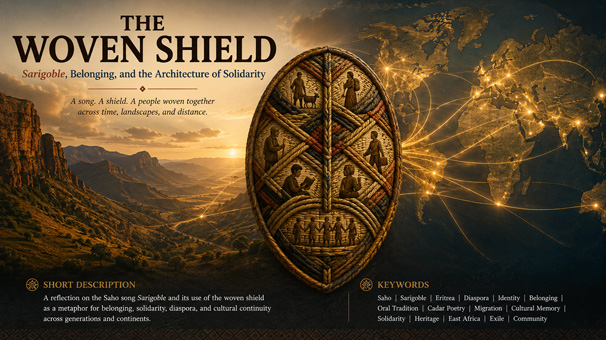
Sarigoble, the Woven Shield of Siolidarity
What can a song teach us about belonging? Through the celebrated Saho composition Sarigoble by Ali Abdullah Ahmed, this essay explores the enduring ties that bind people to one another across landscapes, generations, and continents, revealing how music becomes a portable homeland and a living architecture of solidarity.

Eritrea, Saho, Sarigoble, Ali Abdullah Ahmed, Migration, Diaspora, Identity, Belonging, Heritage, Oral
Tradition, Cadar, Community, Cultural Memory, Solidarity
Sarigoble, Belonging, and the Architecture of Solidarity
Dedicated to Eritrean veterans whose sacrifices, memories, and enduring commitment continue to shape our understanding of home, exile, and belonging, and to those who paid the ultimate price for Eritrea’s independence.
The song arrived the way many meaningful things arrive in life: quietly. There was no lecture attached to it. No explanation of its cultural significance. No discussion of oral traditions, social organization, or symbolic meaning. There was simply a recommendation from someone whose judgment I respected.
“Listen.”

Like many people living in multilingual societies, I have often found myself drawn to songs whose words I do not fully understand. Sometimes meaning arrives before translation. A melody, a voice, or a rhythm can communicate something that precedes language itself.
That was my experience with Sarigoble. The song has accompanied me for some time now. The first time I listened, I understood very little of the lyrics. Yet I found myself returning to it. There was something familiar in the song’s emotional texture. It carried a sense of continuity, of connection, of people bound together by something larger than themselves.
I listened again. And then again. Over time, curiosity replaced uncertainty. I wanted to understand what the song was carrying and why it seemed to resonate so strongly among those who knew it well. The answers did not come from dictionaries. They came from conversations. Friends, colleagues, and members of the Saho community helped illuminate meanings that were not immediately visible to an outsider. What emerged from those discussions was not merely an explanation of a song, but a glimpse into an entire worldview. Only then did I encounter the image at the heart of Sarigoble: the woven shield.
The discovery felt unexpectedly profound. What I had initially experienced as a beautiful piece of music revealed itself to be something more enduring: a meditation on solidarity, mutual dependence, and the social bonds that enable communities to survive across generations. This realization led me to listen to the celebrated Saho composition Sarigoble by Ali Abdullah Ahmed differently. Although I do not speak Saho and cannot claim a literal understanding of every word, I gradually came to appreciate that the song carries meanings extending well beyond melody. Long before I understood anything about its cultural context, I sensed that it was carrying something larger than music itself.
The first thing I learned about Sarigoble was that it was a shield. Not a weapon. A shield. Something woven together for protection. The image stayed with me long after the music ended because it seemed to capture something fundamental about how communities survive. A shield derives its strength not from a single strand but from the interweaving of many strands. Alone, each remains vulnerable. Together, they create something capable of withstanding forces that would overwhelm any individual component.
Within Saho oral traditions, Sarigoble refers to an interwoven shield. Yet the shield functions as more than a physical object. It becomes a metaphor for the community itself. Through the poetic traditions of Cadar, the shield symbolizes solidarity, mutual dependence, and the understanding that collective survival requires cooperation rather than isolation.
What fascinated me most was the horizontal nature of the metaphor. The shield possesses no apex. No single strand occupies a privileged position. Protection emerges from interconnection. Strength arises through participation. The image suggests that belonging is not something granted from above but something woven together from the side. For diaspora communities, such metaphors acquire additional significance.
Migration often scatters people across continents, languages, and political systems. Physical proximity disappears. Familiar landscapes become distant memories. Yet communities continue searching for ways to preserve continuity across separation Music frequently performs that work. Songs become portable homelands. They become vessels through which memory, values, geography, and identity travel across borders.
For many members of the diaspora, the homeland survives through surprisingly ordinary things. A song heard in a car while driving home from work. A phrase spoken in a mother tongue after weeks of speaking another language. A recipe prepared exactly as a grandmother once prepared it. A photograph carried through multiple countries. A key preserved long after the door it once opened has disappeared.
Such objects and practices are often dismissed as sentimental attachments. Yet they perform important social work. They connect individuals to a larger story than the one unfolding in the present. They remind migrants that movement across borders does not require the abandonment of memory. The homeland persists not only in territory but also in habits, rituals, sounds, and relationships that travel with people wherever they go.
In this sense, the diaspora does not merely remember home. It continually recreates home through everyday acts of remembrance. In the case of Sarigoble, the song creates what might be called a transnational acoustic space. References to mountains, valleys, settlements, and landscapes allow listeners to reconstruct a mental geography of home regardless of where they happen to live. The homeland becomes audible.
A person listening in Africa, Europe, the Middle East, Australia, North America, South America, or elsewhere may be physically distant from the places invoked in the song. Yet for a few moments, distance collapses. Geography is transformed into memory, and memory into presence. This process is particularly important because migration does not merely relocate people. It transforms them.
The migrant adapts to new institutions, languages, customs, and ways of life. New layers of identity emerge. Yet older layers persist. Cultural memory survives not because it remains frozen but because it finds new forms of expression. Songs are among those forms. They allow continuity without requiring immobility. They permit change without demanding forgetting.
Many migrants imagine return as the resolution of exile. The assumption seems intuitive: if departure created the wound, then return should heal it. Yet reality is often more complicated. The homeland continues evolving in the migrant’s absence. Neighborhoods change. Languages acquire new expressions. Generations emerge with different experiences and expectations. At the same time, the migrant undergoes transformations of their own. Years spent navigating unfamiliar institutions, languages, and cultural environments leave lasting imprints on the self.
As a result, return frequently becomes an encounter between two forms of change. The homeland that remained is not identical to the homeland that was remembered. Likewise, the returnee is no longer identical to the person who departed. What emerges is not a simple homecoming but a meeting between different versions of history.
The more I reflected on Sarigoble, the more I came to appreciate the wisdom embedded within its central metaphor. A shield woven from many strands offers a lesson extending far beyond one community or one nation. Human beings survive through connection. Communities endure through participation. Belonging is not inherited once and for all. It is continuously woven, repaired, strengthened, and renewed.
At a time when migration, displacement, and social fragmentation are increasingly defining features of the modern world, the image of the woven shield feels especially relevant. It reminds us that resilience is rarely an individual achievement. It is often the product of relationships sustained across families, communities, and generations. Indeed, that is why the image continues to resonate. It reminds us that identity is not only something we carry within ourselves. It is also something we create together. And like the finest woven shield, its strength lies not in any single strand but in the bonds that hold them all together.