Category: Articles
-

Sharpening the Pen to Defend Eritrea When the War Ignites.
The tensions, the constant beating of war drums, the tragic news of Eritreans drowning at sea, and the social media posts announcing those who have gone missing while crossing borders have all been weighing heavily on Eritreans. But above all, the rising drumbeat of a new war between Eritrea and Ethiopia is making people anxious.…
-

The Cycle of Blame: Why Tigray Can’t Learn from the War
Author’s Note This essay examines a recurring pattern in Tigray’s post-war political culture: the public’s tendency to celebrate leaders during moments of triumph and condemn them during moments of failure, while rarely acknowledging its own role in shaping those outcomes. Using the popular Tigrinya-language sitcom Gere Emun (“Gere the Trustworthy”) as an entry point, it…
-

Conditions Required for Trust-Building Efforts
The state of our youth today reminds me of a play I came across during my time as a student: Look Back in Anger, by British writer John Osborne, which premiered in London in 1956. To give a general overview of this play, it is considered one of the most prominent works that launched the…
-

Reflection on the North Star
Editor’s note: the byline data is corrupted; so far we couldn’t resolve the technical problem. The writer of this article is Semere Andom (iSem). Last week, I had the privilege of joining a group of friends to read and reflect on Mekonen Tesfay’s book The North Star: The Biography of Dr. Fitsum. Here is the…
-

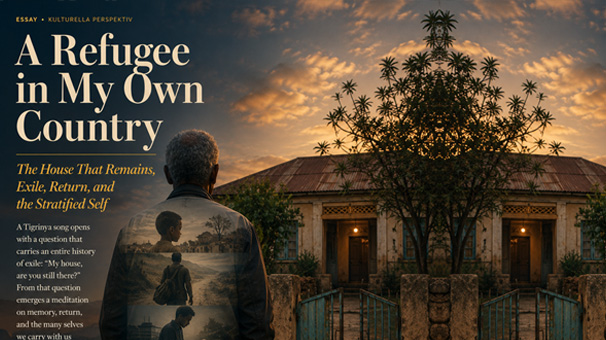
Refugees Speak Back: Unsettling Exile and Home
In 2007, the Red Sea Press published Sadia Hassanen’s Repatriation, Integration, or Resettlement? The Dilemmas of Migration among Eritrean Refugees in Eastern Sudan. Based on her doctoral dissertation, the book quickly became one of the most important studies of Eritrean refugees in Kassala and surrounding camps. It asked a simple yet unsettling question: what or where…
-

A Return of Sorts to Religion
In a much-publicized recent religious event at the Anda Mariam Tewahdo church, many of the top Eritrean officials were seen at the forefront, solemnly bowing and kissing the cross. In principle, such an occurrence shouldn’t be unusual in a country with a mix of Christians and Muslims. Adherents to faith, regardless of their social status,…
-

A Critique of Bereket Habtemariam’s Proposal on Sea Access and Sovereignty
Author’s Note: This essay is written in response to a document recently shared by Bereket Habtemariam on his Facebook (also known as Biko Steph). His contribution to the debate over Ethiopia’s access to the Red Sea is imaginative and provocative. Importantly, Bereket has been open that his intention is not to prescribe a final solution,…
-

More Reflections on Alemseged Tesfai’s Epilogue
This is not a proper article but rather a collection of thoughts … I started off well, but I was too weak to continue. I was very surprised when I watched a video of a group of PFDJ supporters—the Eritrean regime’s party members—welcoming Alemseged in the embassy hall in London, clapping rhythmically in a rising…
-

The Religion of Eritreanism in Exile
Author’s Note: This essay is not a tactical critique of government or opposition, but an attempt to reframe how we think about Eritreanism itself. I argue that in exile, Eritrean identity has taken on the qualities of a religion (sustained by longing, ritual, and taboo), which creates a pseudo-reality that confuses expression with political participation.…
-

Italian Colonialism (1887-1896): The rise and fall of Shoan and Tigrayan Politics
Italian strategies of colonialism in Ethiopia, 1887 to 1896: The rise and the fall of “la politica scioana” and “la politica tigrina.” Background Italy emerged as a colonial power in 1882 when it formally took over Assab from Rubbatino, a private shipping company, that owned the property since 1869. The scramble for Africa was about…
-

Compulsory Service in Eritrea: The President’s Psychological Shadows and Major National Tasks
Authored by: Abdu Fagir posted by awatestaff On July 12, 2025, the graduation ceremony for the 37th batch of national service was held at the famous Sawa military camp. As usual, the ceremony was attended by Eritrean President Isaias Afwerki, who has attended all previous graduations, senior government officials, leaders of the People’s Front for…
-

Open Letter to the Organizers of the August 30, 2025 meeting.
A meeting is planned for August 30, 2025, to form a Registration and Election Commission with the objective of electing a legitimate global representative body to represent justice-seeking Eritreans in the Diaspora. Dear Members of the August 30, 2025 Organizing Committee: I understand you have planned a meeting on August 30, 2025, whose primary objective…
-

Epilogue: History on Custodial Leash
There are moments in literary and historical critique when one feels the sharp tension between reverence and reckoning. To read Alemseged Tesfai’s five-page epilogue to his 490-page historical volume and offer a pointed critique is an undertaking that requires courage, clarity, and context. It is also an undertaking that, if not approached with the utmost…
-

Alemseged Tesfai: Is that all what you are?
Debunking Ethiopia’s memos of late 1940s claiming ‘the return of Eritrea to its motherland,’ Margery Perham, a British historian, wrote in 1948 that every sentence in those memos “cried for comment and correction.” That expression came to my mind this week while reading Almseged Tesfai’s five-page Epilogue for the translation of his worthy three volumes…
-

A Voice Between the Banks: A Letter from Sumaya
Narrator of I & Eye: The Mirror, Exile & the Nile Editor’s Note: The following letter comes from Sumaya, the narrator of Beyan Negash’s forthcoming novel I & Eye: The Mirror, Exile & the Nile. As “The River Remembers” continues its literary meditation, she steps forward, not only in fiction but also in conversation with…
-

The Unspoken Debt: Sacrifice, Power, and Consent in Eritrea
Author’s Note: This short essay is written as a reflection on Eritrea’s independence narrative and the moral contradictions embedded in many armed liberation movements. Having grown up in Eritrea and internalized these national stories, I later came to examine them through a more critical lens. With Eritrean Martyrs’ Day approaching, I hope this piece invites…
-

Eritrea: How President Isaias Afwerki took everyone, including the Veteran Freedom Fighters, for a Ride
I aim to demonstrate not only how the former freedom fighters were misled, lied to, and exploited by the regime after independence, but also how their non-interventionist approach betrayed the very people they fought so hard to liberate from Ethiopian rule. One of the most fascinating but confusing stories that ever unfolded in Eritrea is…
-

The Fiddle and the Fiddler:
The Fiddle and the Fiddler: How the Arabs and TPLF Undermined the Eritrean Revolution The story goes: when Haile Selassie dissolved the federation and annexed Eritrea, the Eritrean people erupted in rebellion, and thus the revolution was born. The war lasted thirty years, and ultimately, the Eritreans triumphed. A compelling story. Many Eritreans dismiss the…