


There are few peoples in Africa, and perhaps in the world, who understand the meaning of sacrifice for country more profoundly than Eritreans. If one word defines our modern history, it is sacrifice. Generation after generation gave everything it had, and many gave everything they were, for the dream of an independent Eritrea.
We fought one of Africa’s longest liberation wars and achieved what many once considered impossible: national independence. We prevailed because, despite our political differences, religious, regional, and ethnic identities, and organizational affiliations, we were united by a shared conviction: Eritrea belonged to its people, and Eritreans possessed an inalienable right to determine their own future.
Ours was a classic David-and-Goliath struggle. We faced a far larger and better-equipped adversary backed first by the United States and its allies and later by the Soviet Union and its allies. Yet we persevered because ours was not merely a military campaign. It was a people’s revolution. Fighters carried the burden on the battlefield, but victory was made possible by farmers, workers, students, refugees, parents, and members of the Eritrean diaspora. In one way or another, the entire nation contributed.
The harsh conditions of the liberation struggle forced us to focus on what was most urgent: ending foreign rule. Other important questions, including how power would be constrained after independence, were deferred for another day. In the process, Eritrea failed to develop the institutional guardrails needed to prevent the concentration and abuse of power. The result is that today’s Eritrea resembles less a republic governed by laws and accountable institutions than a state dominated by one man and a narrow circle of loyalists.
As tensions once again escalate along the Eritrea-Ethiopia border, with reports of artillery exchanges, drone strikes, and limited military engagements in several sectors, the most important question facing Eritreans is not whether we can fight. History has already answered that question. The real question is whether another war is necessary.
Do we have to fight, or do we have other choices?
To answer that question honestly, we must first be willing to call things by their proper names. Nearly every conflict into which the Eritrean regime has drawn the country over the past three decades has been a war of choice rather than necessity. These conflicts had little to do with safeguarding Eritrea’s vital national interests and much to do with the ambitions and calculations of a ruler who, over more than three decades in power, has consistently shown greater concern for preserving his authority than improving the lives of his citizens.
Militarization and indefinite mobilization have become central pillars of the regime’s survival strategy. At the same time, the mass exodus of Eritrea’s youth has hollowed out the nation, depriving it of its most valuable resource: its people.
Yet throughout these years, Eritreans have repeatedly answered the call whenever the country’s sovereignty appeared threatened. Men and women rallied behind the flag and paid a heavy price to defend the nation. Even today, despite exhaustion, disappointment, and sacrifice, I have little doubt that Eritreans would once again rise to defend their homeland if genuinely required.
But patriotism also requires honesty. We must be clear-eyed about where the greatest threat to Eritrea’s future originates.
The challenge from Ethiopia is neither new nor surprising. Eritreans understand Ethiopian political culture well. Whether power in Addis Ababa has been dominated by Amhara, Tigrayan, Oromo, or other elites, successive governments have often viewed Eritrea through a similar strategic lens. Prime Minister Abiy Ahmed differs from many of his predecessors mainly in style. He tends to express his ambitions more openly rather than cloaking them in diplomatic language. Like previous Ethiopian leaders, he has shown a willingness to seek external support in pursuit of his objectives. During the Tigray war, Eritrean soldiers tragically became part of that equation.
None of this should be dismissed. Eritreans have every right to defend their country militarily, diplomatically, and legally against any external threat. We have done so before and will do so again if necessary.
Yet the gravest threat to Eritrea’s future comes not from across the border but from within.
External threats can often be confronted in a battle, a campaign, or a diplomatic effort. Internal decay is different. It arrives through a thousand cuts spread across years and decades. It manifests in weakened institutions, squandered opportunities, youth driven into exile, independent voices silenced, and a population denied meaningful participation in shaping its future.
Eritreans take pride in being nationalists, and rightly so. Nationalism sustained us through our long struggle and helped secure our independence. But Eritrea now needs more than nationalism. It needs patriotism. As Mark Twain observed, “Patriotism means supporting your country all the time, and your government when it deserves it.” The regime of Isaias Afwerki has not earned such support.
Yet many Eritreans still conflate loyalty to the nation with loyalty to the regime. They view criticism of the government as betrayal when unquestioning support for failed policies and unchecked power is the deeper betrayal. A patriot’s highest allegiance is not to a ruler, a party, or a government, but to the nation and its people. Governments are temporary. Eritrea endures.
Whenever tensions with Ethiopia rise, some argue that all differences must be set aside and everyone must rally behind the government. Unity in defense of the country is noble. Unity behind an unaccountable regime is something entirely different. For nearly three decades, the government has deliberately blurred the distinction between state, nation, and ruler. To support Eritrea, we are told, is to support the regime. To criticize the regime is to betray the nation.
This is both false and dangerous.
I recently watched a clip from a Mekhete gathering in Washington, D.C., where opposition figure Kesete Abraha explained his participation by saying that he puts country first. The sentiment is admirable. The issue is not whether Eritrea comes first. Of course it does. The question is whether public displays of support for the regime strengthen Eritrea or strengthen the very system that has weakened Eritrea for decades.
His position reminded me of the famous words attributed to Thomas More before his execution: “I die the King’s good servant, but God’s first.” Many well-meaning Eritreans seem to be expressing a similar sentiment: “I remain a member of the opposition, but Eritrea comes first.”
The difficulty is that the regime has spent decades insisting that it alone embodies Eritrea. When opposition figures participate in regime-sponsored mobilization efforts, the distinction between support for the country and support for the government becomes blurred. The result is often a weakened opposition and a strengthened regime.
I also watched another clip that struck a very different tone. One of Eritrea’s most respected artists, Mehari Fihira, spoke not of mobilization or war, but of peace. His words carried the weight of experience. He observed that no one despises war more than those who truly know it. Having witnessed its devastation firsthand, he expressed the hope that Eritrea’s younger generation would be spared the horrors that consumed previous generations and instead devote itself to science, technology, education, innovation, and nation-building.
I could not agree more.
Those who know war best have a special responsibility to speak out before another generation is sacrificed. Experience should not merely teach us how to wage war. It should teach us how to prevent it. Veterans, former fighters, artists, intellectuals, refugees, and ordinary citizens who have lived through war understand better than anyone what is at stake. Their silence at moments such as this would be a disservice to the nation.
For too long, Eritrea’s youth have been asked to carry rifles when they should have been carrying textbooks, laptops, engineering tools, and scientific instruments. Nations do not secure their future through endless mobilization. They secure it by educating their citizens, strengthening their institutions, encouraging innovation, and creating opportunities that allow young people to build meaningful lives in their own country.
This raises another important question. The regime often presents itself as the guardian of Eritrea’s sovereignty and survival. Yet after decades in power, Eritreans remain denied something fundamental: transparency and accountability.
Eritrea is blessed with significant mineral wealth. Gold, copper, zinc, and other resources belong to the Eritrean people, not to any government or individual. Yet there is no meaningful public accounting of how much revenue these resources generate, how the funds are spent, or how they benefit ordinary citizens. Decisions involving enormous national wealth remain concentrated in the hands of a narrow circle of officials while the public is expected to accept assurance without scrutiny.
To many Eritreans, it appears that only President Isaias Afwerki and a handful of trusted associates know the true extent of the revenues generated from the country’s mineral resources.
No nation can develop sustainably without accountability. Citizens have a right to know how their wealth is managed. They have a right to ask whether revenues from mining and other resources are being invested in schools, hospitals, infrastructure, and economic opportunity, or disappearing into opaque structures shielded from public oversight.
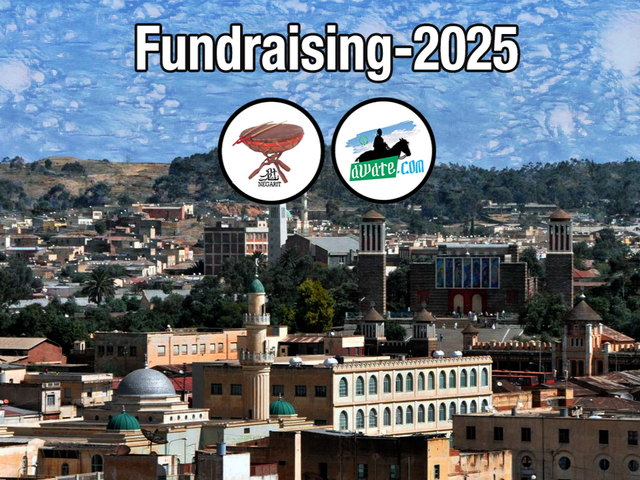
This reality also exposes the hollowness of recurring calls for diaspora fundraising campaigns in support of the regime. Whatever may be collected from Eritreans abroad, the government’s access to the nation’s natural resources far exceeds what can realistically be raised through such drives. The issue is not a lack of resources. It is the absence of transparency regarding how those resources are managed and for whose benefit.
If national unity is genuinely required, the government should openly acknowledge the legitimacy of Eritreans outside its political camp. Yet this is a regime that has consistently treated dissenting voices not as fellow citizens with differing opinions, but as traitors and foreign agents.
Despite this, most Eritreans in the opposition remain willing to contribute to the defense of their country when a genuine national emergency exists and all peaceful alternatives have been exhausted.
What they should not be asked to do is provide political cover for unnecessary conflicts or lend legitimacy to wars initiated by a leadership that has repeatedly demonstrated a preference for confrontation over diplomacy.
The greatest service Eritreans can render their country today is not unquestioning obedience but responsible citizenship. Defending Eritrea requires more than defending its borders. It requires defending the rights, dignity, resources, and future of its people.
Those who know war have a duty to halt the march toward another one. Those who love Eritrea must find the courage to distinguish between loyalty to the nation and loyalty to a government. And those who sacrificed for Eritrea’s freedom must ask whether that freedom can ever be complete while power remains concentrated in the hands of one man and a small circle of loyalists.
The surest path to lasting peace, genuine sovereignty, and national renewal is the emergence of an Eritrea governed by laws rather than men, institutions rather than personalities, and citizens rather than subjects.
Eritrea deserves peace. Eritrea deserves accountability. Eritrea deserves a future in which its young people are known not for the wars they fight, but for the discoveries they make, the businesses they build, and the prosperity they create.
For that future to become possible, Eritreans must confront a difficult truth: the greatest threat to the nation is not merely the danger beyond its borders, but the system that has impoverished its people, emptied its villages, militarized its society, and left an entire generation without a meaningful stake in its future.
The responsibility of those who know war is not to prepare the next generation for battle, but to spare them from one. The responsibility of patriots is not blind loyalty to a ruler, but fidelity to the nation and its people.
That is the Eritrea worth defending.
That is the Eritrea worth sacrificing for.
And that is the Eritrea future generations deserve to inherit.
To Contact the Author: weriz@yahoo.com