
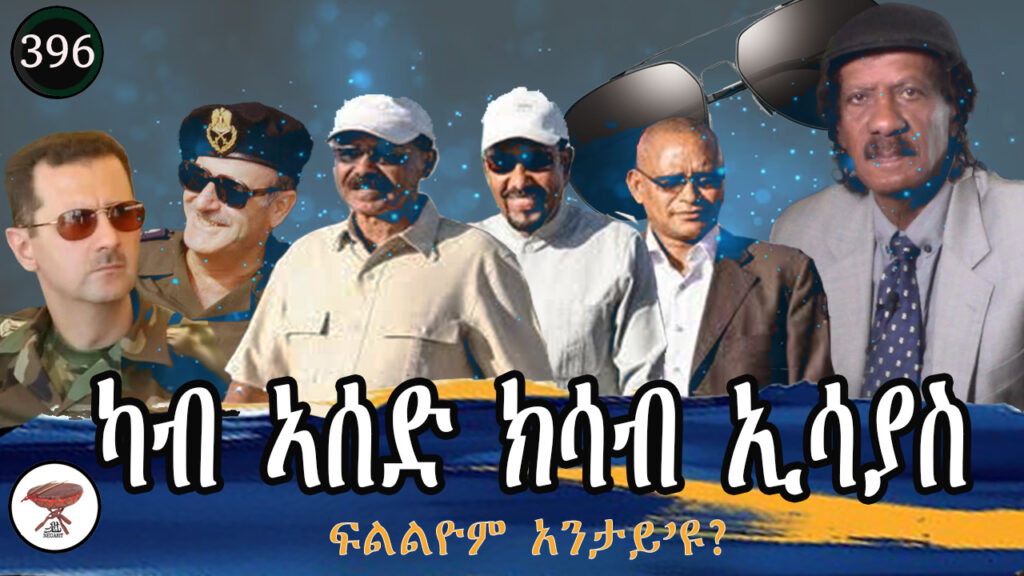

Is there a similarity between Assad’s Syrian Baath Party and Isaias Afwerki’s PFDJ? Was the Baath Party Islamist and sectarian? Was the PFDJ sectarian, as many perceived it to be from the 1970s to the 1990s? Will the PFDJ face a predicament similar to that of the Baath Party? Many people do not know that the Baath regime brutally suppressed the Muslim Brotherhood.
This is Negarit 296. Dehan TsinHo!
By the end of the 1970s, Hafiz al-Assad had consolidated his power in Syria. The presidential election had become a simple Yes-or-No referendum, with the president and the institutions subordinate to him operating within a system designed to maintain his rule.
Assad held several such referendums between 1971 and 1991. The last was held in 1992, soon after Eritrea was liberated.
That year, a person who worked under me in Kuwait asked for permission to go to the Syrian embassy to vote.
I thought it would take him the whole day, but he returned a little over an hour later. Surprised, I asked, “That fast! Did you vote Yes or No?”
Donate
The colleague was Kurdish and not particularly fond of the Baath Party. Matter-of-factly, he explained that he had found someone holding the passports of people who had asked him to vote on their behalf.
“I gave him my passport,” he said.
I was curious. “Did you tell him to vote Yes or No?”
“I didn’t. He can only vote Yes,” he replied, making a face that expressed surprise at my silly question.
The polling station was supervised by the embassy, and voting No was practically unthinkable. How else could Assad boast of 99.9% approval?
Is There a Similarity Between Assad’s and Isaias’ Rule?
Isaias became a factional leader in 1970, a position he formalized by issuing the Nehnan Elamanan manifesto (We and Our Objectives). Hafiz al-Assad also came to power in 1970, pursuing a pan-Arab vision.
By the 1980s, Assad had eliminated virtually all semblance of democratic rule. He purged the Baath Party of actual and potential rivals, consolidated his power through a system heavily dependent on the Alawite community, and gradually turned the party into a docile institution beholden to his decisions.
By the same period, Isaias had also consolidated his control over the PFDJ.
Syria has a population of around thirty million, while Eritrea’s population is estimated at anywhere between four and seven million. Take your guess: the Eritrean government does not publish a reliable, current population figure, and the number has long been treated as a sensitive matter.
Eritrea PFDJ and the Baath Parties
Iraq and Syria, both ruled by secular Baathist parties, generously supported the Eritrean liberation forces from their early days. Many Eritrean cadres received political and military training through Syrian and Iraqi institutions associated with the Baath regimes.
In the late 1960s, the Eritrean punishment force, known as EQAB, was established by the late Osman Saleh Sabbe in response to the scorched-earth policy Ethiopia unleashed on Eritrean villages. The objective of that policy was to “empty the sea to eradicate the fish”—to destroy the countryside and deprive the Eritrean liberation movement of its support base.
The Ethiopian army swept through large areas of Eritrea. Soldiers torched villages and killed livestock, while fighter jets rained destruction from the sky. Hundreds of thousands of people were displaced, many of them fleeing to Eastern Sudan, where Eritrean refugees endured harsh conditions in camps.
EQAB intensified its activities and carried out spectacular attacks on Ethiopian targets, including aviation-related targets.
Since some of the liberation forces’ most reliable foreign offices were located in Syria, statements claiming responsibility for operations were often issued from Damascus. Ethiopian media responded with ruthless openly bigoted anti-Arab and anti-Muslim rhetoric. Its propaganda sought to portray the Eritrean liberation struggle as a Muslim movement.
That campaign contributed to a serious sectarian divide, the effects of which can still be seen among some Eritreans today.
The Baath Party and the Muslim Brotherhood
In 1982, Assad unleashed a devastating military assault on the city of Hama, targeting the Muslim Brotherhood and other opponents of his regime. The crackdown killed thousands of people; estimates of the death toll vary widely, with some reaching approximately 30,000.
The Baath Party was a pan-Arab nationalist, socialist, and secular movement, not a party founded on religious doctrine. Its co-founder, Michel Aflaq, was a Greek Orthodox Christian from Damascus, Syria.
Yet some people continue to hold on to perceptions shaped by the sectarian policies of Haile Selassie’s rule. Such perceptions remain useful to those who seek to divide Eritreans along religious lines or portray particular segments of the population, or organizations within the Eritrean struggle, as belonging to one religious camp.
This served to widen the manufactured Islam-versus-Christianity dichotomy.
During Hafiz al-Assad’s rule, graffiti appeared on a wall bearing the words, “La ilaha illa al-watan, wa la rasul illa al-Baath”—roughly, “There is no god but the homeland, and no messenger but the Baath.”
It was a deliberate parody of the Islamic declaration of faith, the shahada: “La ilaha illa Allah, Muhammad rasul Allah”—”There is no god but God, and Muhammad is the Messenger of God.”
For Muslims, the shahada is the fundamental declaration of faith.
Journalism and Totalitarian Regimes
There is another similarity between the Baath and the PFDJ: propaganda and obsessive control.
National media outlets have little purpose beyond serving the regime. They are staffed by armies of so-called journalists who would rather be found dead than be caught challenging the ruling party.
Patrick Seale was a well-known British author and journalist. But he also illustrates a familiar phenomenon captured in an Arabic saying: Man ‘ashara qawman arba’ina yawman, sara minhum—roughly, “Whoever lives among a people for forty days becomes one of them.”
Seale spent considerably longer among Syrians, particularly those close to the Assad regime.
A journalist who serves a cause and becomes deeply embedded in a regime can inevitably be influenced by that relationship. It is a syndrome that afflicts many propagandists.
Seale was so close to the Syrian regime that he reportedly enjoyed access to its highest circles. Through his writing, he helped shape Western perceptions of the Assad government, presenting the regime’s narrative with considerable skill.
Patrick Seale died in 2004 at the age of 82. Allah yerhamu—may God have mercy on him.
Now I am curious: what parallels can you draw between these two oppressive, long-lasting regimes? Please share your views in the comments section.