
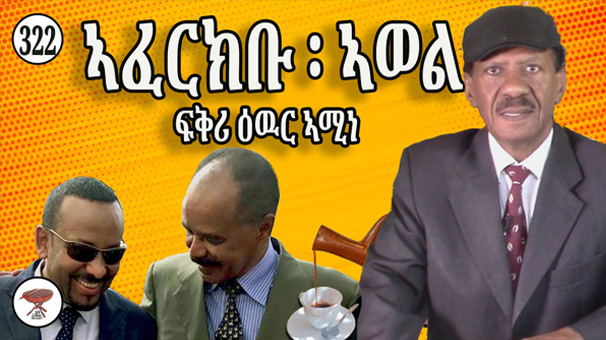
Negarit 322: Emergency – A Fresh Cup of Coffee
A deep dive into Rousseau's Social Contract and how it applies to the diplomatic impasse between Eritrea and Ethiopia. Why understanding the foundations of justice, negotiation, and power is vital to resolving regional conflict—and why failing to do so is an Aferkebu, an emergency. With cultural reflections, political satire, and critical analysis, this video explores how intellectual honesty and negotiation skills can pave a way out of deadlock.

Jean-Jacques Rousseau, Genevan (modern Swiss), was born in 1712 and died in 1778. He was a philosopher and writer, best known for his political philosophy, which deeply influenced the Enlightenment and, to some extent, the French Revolution of 1789. His work laid the foundation for modern political and economic thought.
Among Rousseau’s core contributions is The Social Contract, a work that proposed the idea that legitimate political authority comes from a contract agreed upon by all citizens for their mutual preservation. This principle remains a cornerstone of modern governance.
Since humanity’s earliest days, people have banded together—first in families, then clans, tribes, and eventually nations. These groups cooperated in war, trade, and mutual protection. Over time, they developed laws intended to serve all members fairly. These laws form the backbone of the social contract, meant to prevent violations of communal trust. Only under dictatorship does the collective good get sacrificed for power.
Discussing rights and equality is futile when interlocutors lack a basic understanding of the social contract. Without justice and the rule of law, societies are doomed to peril. These are not abstract theories to be shelved—they are urgent matters. Aferkebu. Emergency.
To respond to an Aferkebu, people must understand the concept. A mentality conditioned by oppression, a “slave mentality,” lacks the tools to think logically through such crises. Every sound proposal stems from a coherent concept. The tragedy is that the Middle East broadly—and the Horn of Africa specifically—suffers from intellectual poverty. I will explain.
Face Saving Gesture
Donate
In Negarit 320, I used the term “face-saving.” In our culture, we call it memles geza or TraH eedu keymles. Face-saving is crucial in diplomacy and negotiations. Yet, many responded with hostility, misinterpreting my words through emotional filters instead of thoughtful analysis. Some even leapt to absurd conclusions—like accusing me of suggesting we hand over territory.
It’s disheartening when people refuse to understand their own language. Worse still, some of these individuals are influencers and politicians, shaping public opinion with shallow, populist rhetoric.
Sheikh Siraj’s Eloquence, “Kebur Brezidenti”
To ease the tone of my message, I referred to Isaias as Kbur Brezidenti. It was deliberate—a strategy rooted in respectful communication. Serious topics often require a softened tone.
My inspiration came from Aboy Siraj of Adi Qeyh, whose eloquence once moved me. When he addressed Isaias and his lieutenants, he began with “Kebur Brezidenti,” and voiced his concerns about road safety. His sarcasm was powerful yet respectful. It resonated with me.
Yet, someone accused me of submission for using that term. Absurd. I’m simply waiting for Isaias to apologize to me.
The Horn’s Geopolitical Quagmire
The standoff between Eritrea and Ethiopia requires strategic and imaginative solutions. Abiy’s reckless behavior in an already volatile region cannot be left in the hands of those unfit for the task. They disrupt meaningful discourse—like a fly plunging into your first cup of morning coffee.
The ruling party appeals to a segment that thrives on nationalist bravado bordering on fascism. Years ago, Isaias handed leadership to Abiy with the words, “You lead, we will follow.” And now, the very people who cheered that moment resent a mere suggestion for a face-saving exit from the current deadlock. They know I have no control over Eritrea’s leadership—Isaias does.
Religious leaders often reference Munafiqan—hypocrites. Seems fitting here.
Tough love or shock therapy may be necessary to wake the apathetic. Addressing those with real power requires diplomatic finesse. Whether I like them or not is irrelevant—I fear the harm they could cause if left unchecked.
We’ve seen this movie before: chaos justified by port access, boundaries, and new currencies. The language of provocation always ends in blood.
Some warmongers crave conflict to feed their egos. But would they be so eager if the blood spilled was their own or their children’s?
Conclusion—Another Aferkebu, Emergency
Our intellectual landscape is in dire shape. It must be treated as a national emergency—Aferkebu. The solution? Dismantle the partisan propaganda machine posing as education.
The Arabs say, “etmenna bil batel hata yaatik al haq”—exaggerate your demands to settle for what’s fair. While it’s manipulative, it’s better than total diplomatic failure.
No, I’m not suggesting Eritrea claim the Abay River. But offering competitive port access and reserved berths for Ethiopian trade—like Djibouti does—could break the deadlock. Impasses are costly. Agitation isn’t strategy.
How much longer must the region endure this gridlock? Share your ideas—and hope the regime is listening. Just don’t silence those who speak up. Not everyone has thick skin.