
Iska Warran, Somalis; Tread Carefully!
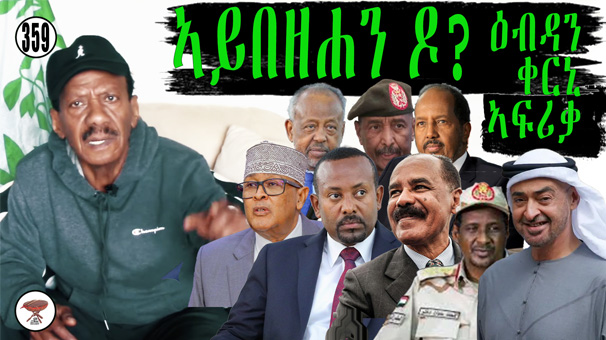
Eritreans have a soft—very soft—spot for Somalia. The same sentiment extends, with varying intensity, toward Yemen, Ethiopia, and even distant Pacific Islands. “We love the world” is the guiding slogan—with some exceptions.
Somalia and Sudan provided critical support until 1991, when Eritrea’s long struggle for self-determination bore fruit. But independence came wrapped in bitter irony: Eritrea emerged as a new state just as Somalia descended into violent chaos. Yemen followed. Then Sudan. The UAE’s ambitions—vast as Macedonia’s under Alexander—stretched from Yemen and Somalia to Syria and Libya. The empire-in-the-making is not yet complete, and it appears unwilling to settle until it unveils its modern Alexander the Great, with horns of Ammon and all.
Somalia was generous to Eritrean refugees. It issued passports—no small favor at the time, but a lifeline. Without Somali documentation, travel for work, education, or medical care was nearly impossible during the struggle years. Freedom of movement was not an abstract right; it was survival itself.
When independence arrived in 1991, Eritreans believed their suffering had ended. They celebrated freedom and dignity while grieving for Somalia, as if their own relief had been purchased by transferring hardship to a brother. No Eritrean imagined that by 2026 their country would still resemble the bleak pre-independence years. And no honorable person would gloat over Somalia’s misfortune. The lamentations of Somalis and Eritreans differ in form, but the pain rhymes—two unfortunate peoples trapped by history and leadership failures. Is this madness going to end?
In the 1990s, Somalia was devastated by warlords; subsequent regimes proved no remedy. Clannism and ethnic politics compounded the damage, while dictatorship and tyranny intensified grievances already fueled by fanaticism and violence. Eritrea’s lamentation may sound different, but the outcome is the same: paralysis, fear, lost time, and lost opportunity.
Somaliland
Eritreans who sacrificed youth and life for self-determination cannot, in good conscience, deny the same right to Somaliland—even if the historical contexts differ. If unity proves unworkable, peaceful divorce is a rational solution. But it must rest on moral and legal foundations. Once foreign interference enters the equation—particularly the theatrics of a modern Macedonian king—the process is poisoned.
So far, Israel stands alone in recognizing Somaliland’s self-determination—the same Israel that militarily denies Palestinians the same right. That contradiction alone foreshadows the treacherous path awaiting Somalia.
For three decades, Somaliland has demonstrated an extraordinary capacity for self-governance without international recognition, financial integration, or membership in global institutions. To survive—and function—under such isolation is no small achievement. It is, by any reasonable measure, phenomenal.
Somalia did not need to endure such an ordeal. Instead, it remains crippled by internal power struggles, clan rivalries, and sectarian fractures. The piracy episode inflicted lasting reputational damage. Al-Shabab’s relentless insurgency continues to spread fear and instability. Somalia suffers from a chronic power vacuum—warlordism without lords.
Both Somalis must confront the gravity of their condition and engage in genuine dialogue—not the theatrical, decade-long charades that serve elites rather than people. Somali dialogue must function like an ambulance: it must reach the patient regardless of traffic. It must be people-centered, not elite-driven.
“Ethiopia Stretches Its Hands to the Sea”
Eritreans never objected to Ethiopian elites quoting scripture—“Etiopia tabetsih iddeha habe egzabhier (Popularly, habe semay)!”“Ethiopia stretches its hands to the sky.” I wish those seduced by the traditional slogan understood that biblical Ethiopia is not the same as modern Ethiopia. The ancient Greek term “Aethiopia,” meaning “burnt face,” was used for the region south of Egypt, including the region from the great Sahara to West Africa. Classical historians like Herodotus used it loosely for all dark-skinned peoples. A clever European later persuaded a king to appropriate the name for his country. The problem is that today’s elites superimpose all the grandeur of that region onto the modern state of Ethiopia that was once known as Abyssinia.
How the sky and God became the sea remains a mystery—but the Ethiopian ruling party embraced it enthusiastically. Access to the sea became a slogan, then a battle cry, then an existential demand. Soon it escalated into a threat of invasion and calls for a naval base and sovereign territory on the Red Sea shores. The fever cooled temporarily after a reported MoU with Somaliland promising Ethiopia a 20-kilometer coastal stretch met some hindrances.
As expected, the deal was signed over a dormant volcano. It erupted. The idea was dropped. Attention shifted back to Eritrea, accompanied by threats and ominous warnings. The prime minister boasted of troop numbers, drone inventories, and a population of 139 million. Five years ago, the claimed population was 100 million people; in that time span, the claim jumped to 100 million. And the Eritrean ruling party, for its part, outsourced its response to the prosperity party to trolls and unofficial channels. Statesmanship and diplomacy were nowhere to be found.
To this day, Eritrea has not articulated a clear, official position on Ethiopia’s sea-access demand—despite possessing ample legal and diplomatic arguments. Ask Eritreans what their government’s position is, mostly, beyond noise and slogans, and the answer will be silence. Silence, they say, is a virtue. Imagine being represented by a deaf and mute lawyer!
Threats are nothing new to Eritreans; they are familiar lessons repeated for decades. The aggressor’s posture remains unchanged. Only the orchestra changes, not the song or the maestro.
The region would breathe easier if Abiy Ahmed toned down the rhetoric. Provocation and hawkishness have never produced stability here. The Horn of Africa is already overpopulated with reckless dictators and unprincipled, indecisive elites. One leader choosing restraint would be considered a revolutionary.
Recognizing Somaliland
Some may object to an Eritrean advocating inter-Somali dialogue over Somaliland’s choice, asking how Eritrea would have reacted had it faced the same dilemma in 1991. Consider this perspective fraternal advice. A sibling should celebrate another’s pursuit of freedom—even if the advising person’s own house is in disarray.
Ethiopian regimes are addicted to the smell of gunpowder more than the rest. Eritrea’s government, too, appears comfortable amid regional chaos. Sudan, relatively stable for years, was stung by the Horn bug in 2019 and has yet to recover. Somalia remains stuck at the starting line of stabilization, exhausted by the pirate episode and later the appearance of Al-Shabab, while Somaliland risks reckless moves in a race not to be left behind. Djibouti appears calm, but a president fused to his chair offers little reassurance. Like the rest of his colleagues who sit atop a powder keg, bearing a weight far greater than themselves.
Across the Red Sea, the UAE continues refining its imperial laboratory tests—sometimes students outgrow their teachers! The ripple effects touch Egypt, Libya, Saudi Arabia, and beyond.
Solving everything at once is fantasy. A piecemeal approach, however imperfect, prevents collective heartbreak. That is why Somalia and Somaliland deserve immediate focus.
So, warrya, iska warran!
Be wise. Save your country from another cycle of violence and anxiety. Stop the foolishness. Call it a day.

Awate Forum