
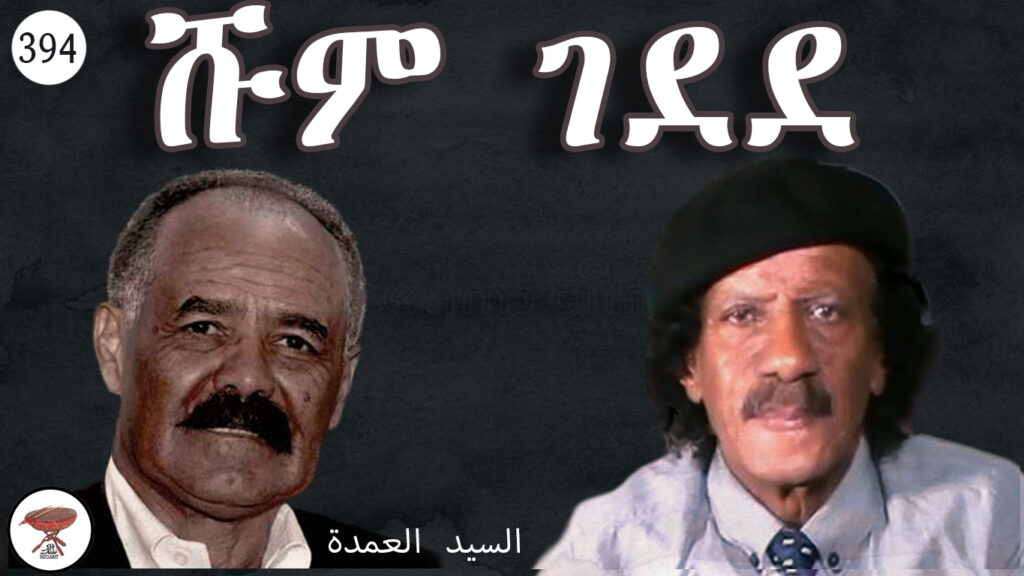

Anta shum gedede, shum gedede
Ab r’som kof ilka meska stte
That’s the oldest song I remember from the earliest years of my childhood. I knew mes, it was the local wine. I knew shum, it means chief. Gedede? I never new what it meant—with some terms you just stop wondering what they mean.
The subject was aboy shum Gebresellassie Medin, a graceful, kind nobleman and chief of Hailb Mentel region. I grew up with his children. His house was Infront of our house just separated by a five-meter-wide street.
On occasions, particularly on Meskel, a group of Girls from Halib Mentel celebrated the festival in that house singing and dancing. It seemed the day would never end. As children we gathered around and mingled in the dances until sunset when the crowd dispersed. Most of the girls walked to their villages. I crossed the street to my house.
It was tradition, not a forced presence. It was not a mechanical celebration ordered by the powers that be—there was no ruling party that monitored the activities. Even the occupying army or its spies didn’t bother the people.
A Leader with a military mentality
Donate
The late Tesfai Tekle was a much-respected military leader during the Eritrean armed struggle. He was stern but unlike a typical commander, he was funny. funny. There is a joke I heard from him long ago and like to tell it on occasions.
The place was somewhere in Barka near the present Sawa military conscripts camp, and the youth around him were as young as today’s conscripts of today, though, unlike today’s conscripts, they joined to fight voluntarily, not coerced.
An excited youth told Tesfai, “I hope you will be the president of Eritrea after independence.”
Tesfai explained what the qualifications of “a revolutionary leader” should be and then told us the joke:
A general came to a military hospital complaining about a head wound. The surgeon immediately put him on the operation table, opened his head, and carefully pulled his brains out. The surgeons cured the brain and sewed the general’s head. He sprung up, stood on attention, saluted the doctors, turned towards the door and walked out to his waiting Jeep. Everybody waved goodbye to him.
The doctors returned inside the operation room and found a nurse distressed—Sirs’ you forgot to put his brains back—they glanced at the table and saw the brains; they had sewed sew the general’s head without the brains.
An officer who observed all sitting behind a desk comforted them: “he is a soldier; he doesn’t need brains.”
Tesfai Tekhle’s conclusion: a military person is not fit to lead a nation of civilians.
Colonels and overthrowing governments
Do you know of a military leader who ruled with justice, freedom and stability in the Horn of Africa? General Swar AL Dahab of Sudan who overthrew General Numeri and ushered the country into democracy doesn’t count. Look around you; most dictatorships are led by military or para-military personalities. However, a few career soldiers overthrew governments, they are mostly colonels, but some are revolutionary commanders. They are generally failures and an embarrassment to their people.
Tesfai Tekle was “A Man Who Saw Tomorrow.”
From Napkins to AI
During the Badme war, there were many Ethiopians and Eritreans who considered themselves war strategists. Everyone pulled a pen, spread a napkin and started to scribble and draw arrows, and kindergarten grade drawing of explosion tanks and mountains…they described everything they thought happened and will happen, with so much ease. This time around, everyone went electronic—you tell AI anything and it will de the rest, better maps that what the mappers of Eisenhower, Patton, and Montgomery produced in WW2.
I miss the coffee shops and the days of drawing on Napkin.
Shum Gedede
The ruling party Eritrea led by President Shum Gedede remembers Eritreans in times of war—which is perpetual. “Stand with your country, protect your sovereignty…” Such appeal to the people is always aired in the context of mobilization for a war. Why do they remember the stakeholders only when they are entangled in a war?
Dictatorships recognize the rights of citizens only to help in the wars that they wage and sustain. They recognize citizens to perpetually milk them for support in the agitation and propaganda they design and manage.
It’s disappointing that some people are willing to be blackmailed repeatedly—a rational, compassionate and responsible citizen cannot ignore the plight of his people or any other people. The saying that, “A country can only be saved and protected under the endless dictatorship is a lame ploy.”
It is better to have a functioning government to face external and internal challenges and any other situation. But if a government is mainly interested in perpetuating its grip on power, control of resources, freezing of the justice system and disenfranchised population, survivalist people may pretend to heed the call, but others who were bitten from the same hole many times will simply say, I am not a fool.
What the PFDJ tried since it held power, practically since 1991, and formally 1993, didn’t work—in fact it was a serious regression. How could a sane person fail to realize that self-centred divisionary politics is the cause? In a multi-ethnic nation, it’s not partisan constituencies alone that make wonders happen. Rulers whose main goal is to preserve power never bring solutions or stability.
On this occasion I would have liked to suggest modest remedies, but I will be foolish to repeat the same suggestions and offered for years. Doing it again for the umpteenth time, knowing dictators are determined not to listen I refrain.
Ab ZeysemAka Debri aytemahlel—Don’t pray under a hill that doesn’t listen to you.