
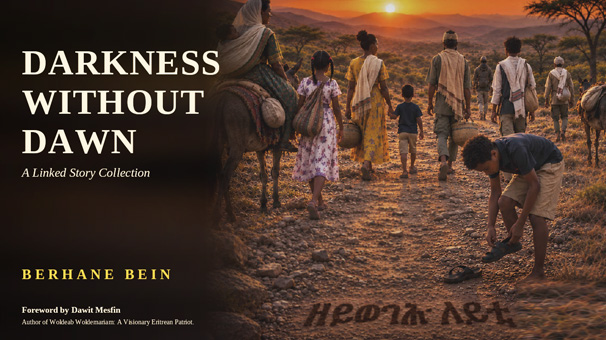
Awate Forum’s iSem Writes his First Book
Darkness Without Dawn is a linked story collection that explores memory, tradition, fear, gender, language, and the complicated ways people negotiate the worlds they inherit. The book grew out of a long engagement with writing and with a community of readers and writers whose conversations, disagreements, encouragement, and criticism became part of the journey. Darkness Without Dawn will be released on October 30, 2026. Pre-orders are now available.

I am immensely delighted to share with the community, and writers I adore: the broader Awate.com community, that I have finished my first book, a linked story collection: Darkness Without Dawn.
I have always believed and was told that writing is a lonely process. But I do not hold that view anymore, as I discovered during the writing process that it is a community behind every writer
And I that spirit, I would like to thank Saleh Gadi Johar for his commitment and tenacity to nurture the Awate community, and for sharing his experience of writing and the booby traps along the way with me, so I did not have to experience them myself.
I am also immensely indebted to Saleh Abdu Younis for reading my manuscript. He read it while going through the personal tragedy of his brother’s sickness. I thank him for his humor, his optimism, his sober debates, and his obsession with the literalism that now infects the Tigrinya language, an obsession I share.
I would like to thank the stalwarts of Awate.com and the Awatistas: Ismail AA, for his exemplary elevation of our debates. I learned a great deal from Ustaz Ismail AA about rhetoric, debates, and history.
I would also like to thank other Awatistas from whom I have learned, including Beyan Negash and Ismail Omer Ali, who, through their articulate articles, respectful engagements made us think, and whose style in deploying the language I have enjoyed.
Donate
I would also like to thank Memhir Amanuel Hidrat for his steadfast and inspiring stand inall Eritrean social arena, and for always prodding me: “You like to write, so write.”
I would like to thank Mahmud Saleh, once an active contributor to Awate. We never agreed on anything. We even disagreed about his own mother tongue, Tigrayit. In one of our heated debates about Tigrinya and Tigrayit lyrics, he called me a “purist,” to which I replied, “I take that as a compliment.” Mahmuday, as we used to call him endearingly, always reminded me that my politics was wrong, but my writing was right, and to stick to the latter.
I disagreed with that, too.
I would be remiss if I did not thank Semere Tesfamichael for his inspirational series of articles that diagnosed some of our history and, above all, for his invoking Swift’s Gulliver’s Travels, which jolted me to revisit the classic and see it through adult eyes.
Darkness Without Dawn will be released on October 30, 2026. You can pre-order a copy through the following:
Email: book@wawpress.com
Facebook page: https://www.facebook.com/profile.php?id=61581864273435
Whatsapp Number: 416 564 9602
Excerpts from Darkness Without Dawn
- Darkness Without Dawn
A woman was in prolonged labour. At last, the traditional midwife helped the newborn out of its mother’s womb into the world. She swaddled it in a white towel, peeked between its legs, and whispered to the gathered women, who erupted in jubilation, ululating seven times, heralding the birth of a boy. They would have ululated three times—less than half, if it were a girl.
An earshot away, a man paced, circling his garden. Unlike before, his beloved flowers and plants offered no serenity. To distract himself, he turned on the news. The garden and the news were his happy pursuits, and politics. Today, he listened to reports of Americans pounding their chests, celebrating the successful landing on the moon—in the Sea of Tranquility. But he did not feel tranquil.
- Dawns Journey
Wegahta has two fears in life: marrying the son of her father’s killer, and the village women inserting tomatoes of different sizes into her to validate her virginity.
As a twelve-year-old, Wegahta recalls a lesson she learned about tradition at her seventeen-year-old cousin’s wedding. After the groom confirmed his bride was indeed a virgin, he smeared the blood onto a white handkerchief and handed it to the best man. The best man lifted it high toward the women, their eyes wide with anxious anticipation. The blood-
stained cloth, the flag of virginity, appeared. They knew their daughter, friend, or kin had been certified chaste. Pride and joy burst from them and a song rose in the yard: Taamanit, ye Taamanit (the trustworthy daughter).
Wegahta still remembers the colour, the heat, the hum of voices, the strange mixture of fear and fascination.
The people in her village, like her, have two fears. They fear a moonless night, as the devil roams in the dark to seize anyone who steps into his kingdom—darkness. And you better not whistle at night, lest you summon him. They also fear perishing from starvation after poor rainfall results in crop failure.
Wegahta thinks the fears of her fellow villagers are absurd. Absurd and irrational. The devil does not slap. She even dares the devil and whistles to summon him, her, it. Dares to break the tradition that a woman ought not whistle. And there is a solution for a poor harvest. Wimps, build a cooperative granary and save the harvest during a bountiful season.
One Friday evening, as dusk is falling, Wegahta is heading home from her weekly chore of collecting firewood. She speaks her name to herself, Wegahta, then repeats it fondly, nostalgically, the way her late father used to: Wegihula. And she remembers it means dawn. Born after a prolonged infertility and prayers, her parents named her Light after Darkness. She giggles at the irony of her name.
Since her father’s death during a fight over land, she knows the village elders and her relatives have been in discussions to settle the spilled blood and avert the cycle of revenge. She’s discerned it from hushed voices, from the whispers of women, from the girls who stop talking when she approaches. The village grapevine, ever vibrant, ever vicious. Her mother does not protest, and Wegahta does not blame her. Her mother cannot go against the elders: men, dominant, powerful. Wegahta senses she may soon be given as a bride to the young man whose father killed her own, so they can create bloodline. After all, blood relatives are not supposed to kill, betray each other, or take revenge on one another.
She ties her braided hair into a bun, slings the rick of firewood across her back, plods toward her house. A sudden thought seizes her—a vow to confront her twin fears. It sears into her mind, settles in, settles down. Her fears are twins, yet the solution is one: she will fight them. For herself, for her baby sister. She even imagines liberating all the women in her village, in her country. Riding the high of this audacious ambition, she quickens her pace, striding with purpose, vigour. She is not racing the darkness; she is hurrying to catch her baby sister before she sleeps, to steal a final moment of play, and slumber early so her mind can dwell on the daring plan that now drives her.
Dinner is injera with shirro, her least favourite. Sensing her disappointment, her mother boils milk to placate her. Wegahta beams. Now she can down her kicha with hot cow’s milk. She hates the texture of the injera, soft and spongy. She hates the smell of shirro, spicy; it tickles her nostrils, burns her tongue. It beats her why one would go through all the trouble of turning chickpeas into this powder that is shirro.
“Injerra and shirro should be banned,” she tells her mother.
“What will you do if you a marry a man who loves shirro?”
“I will cross that bridge when I am on it. If I am ever on it.”
“You will be on it ezza guallay. What is life without a husband?”
“Or I will marry a man who loves milk, meat and kicha.”
Together they contemplate a wealthy farmer who owns hundreds of cows and sheep, a man who, when thirsty, never drinks water, instead commands a servant to milk a sheep or cow and fetch him fresh foaming milk. Meat, milk, and honey in the hive—the perennial symbols of wealth and class. Males in the house—a symbol of strength, Weghata thinks.