
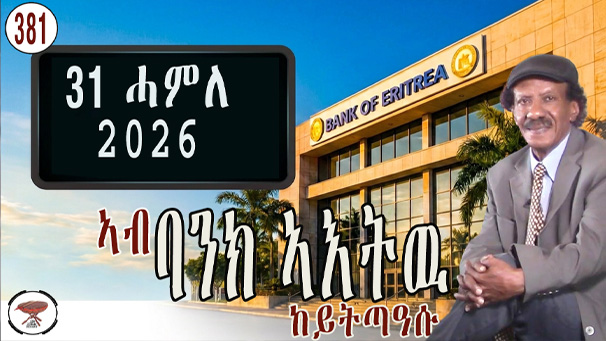
Deposit Your Money or Else: Eritrea’s Banking Ultimatum
Eritrea's latest directive orders citizens and businesses to deposit cash into banks by July 31 or face legal action. This analysis examines the official notice, its implications, and what it reveals about state control, banking policy, and citizens' rights.

Two days ago, the Eritrean government issued a legal notice ordering individuals and businesses to deposit their cash in banks by July 31, 2026, or face legal action.
The notice was broadcast on state media as follows:
Legal Notice
It is obvious that every citizen and institution has only the right (sic) to use the national currency. But it is not only a right; it is also a duty. It is illegal for individuals and institutions to hold the national currency outside banks in excessive amounts or for an unlimited period.
Accordingly, those who have bank accounts must deposit such funds by July 31, 2026. Those who do not have bank accounts must open one and deposit the money. Failure to do so will result in legal action.
Bank of Eritrea

The announcement offered no explanation beyond the warning. It appeared to target individuals and businesses that keep cash outside the formal banking system, but it provided no definition of what constitutes an “excessive amount” or how the law will be enforced.
For many Eritreans, the announcement revived memories of similar government measures over the past two decades that inflicted serious damage on an already fragile economy.
Eritrea’s independent press was effectively destroyed in 2001 after a brief period of remarkable growth. Newspapers were shut down, editors and journalists were imprisoned or forced into exile, and several died in detention. Since then, the government has maintained a monopoly over domestic media.
Awate.com was established on September 1, 2001, (mainly through GEDAB NEWS, its news section) to help fill the vacuum left by the closure of the independent press and to challenge the state’s monopoly on information. Over the years, we have documented many such government measures. Revisiting those archives is worthwhile, especially at a time when public memory is often short and official narratives go unchallenged.
Today, social media has largely replaced the role once played by traditional news organizations. While it has broadened access to information, it has also accelerated the spread of rumors, misinformation, and politically driven narratives. Artificial intelligence has added another layer of complexity, making it increasingly difficult to distinguish verified reporting from fabricated content.
Against that backdrop, the government’s latest banking directive deserves closer examination.
It is obvious that every citizen and institution has only the right (sic) to use the national currency. But it is not only a right; it is also a duty.
A signature PFDJ core belief. Rights and duties are inseparable; you can enforce the later without providing the former. The announcement reads like a threat, not information.
It is illegal for individuals and institutions to hold the national currency outside banks in excessive amounts or for an unlimited period.
Why is it illegal for one to hold onto his money unless there is a legal violation? But how do you define what’s illegal in a country run by proclamations and extrajudicial reactions? It is even worse: The government is a monopoly; it is a competitor with police powers, banks, and commercial interests, with leverage over private enterprises.
Accordingly, those who have bank accounts must deposit such funds by July 31, 2026. Those who do not have bank accounts must open one and deposit the money.
A herdsman in a remote village has an upcoming wedding of his son or daughter. He also wants to build a house. He has no banks (doesn’t even know what they do) and prefers to keep his money in his hut, the only means of saving he knows. Besides, banks are found in towns and cities, and the closest town is a day’s walk away. He doesn’t go there because he has herds to tend. He is illegal even if living in his land.
Failure to do so will result in legal action. Bank of Eritrea.
Of course, that final sentence would have done. It’s clear, in spirit and consequences, and it is true to the nature of the ruling party: militaristic. The only mistake I found is calling the bank, “Bank of Eritrea”, It’s the BANK OF PFDJ.
Image courtesy of pexels-kindelmedia