
Ustaz AbdulHamid: Among the Few Left from the Umma Generation
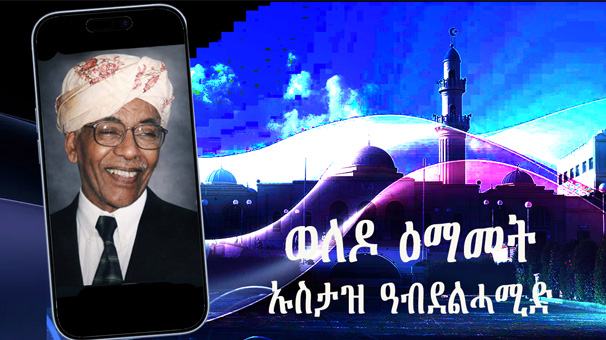
It was Mendefera, on a January morning in 1929. The wife was expecting; soon, the child refused to remain in the womb and came into the world.
An elderly midwife was there to help. The baby looked healthy. She was glad because her prediction had come true—it was a boy. Smiling, she cupped her hands over her mouth as if forming an umbrella, rolled her tongue, and let out ululations. She counted seven before stopping. The previous night, she had delivered a girl in the neighborhood—three ululations had been enough.
That child would grow into Ustaz AbdulHamid.
The women of the neighborhood had already gathered; no relative would want to miss such an occasion. The kitchen was alive—some feeding the firewood, others fetching utensils and arranging mats for guests. The wood beneath the tripod glowed red and amber, and thick smoke filled the room. One woman had already appointed herself chief cook; she placed a large clay pot on the tripod, filled it with water, a pinch of salt, and flour, and began stirring with an oversized wooden stick. Nearby lay sacks of flour—visitors were expected from far and wide. Every guest would eat the proverbial GaAat, the porridge. But do not mistake it for just any porridge—it is unique, believed to have strengthening qualities; it fortifies the backbone.
That is why the mother of a newborn must remain in bed for at least a week, recovering from the ordeal of childbirth. For seven days, she is nourished with GaAt—what children born in the West now call “Volcano.” Our GaAt resembles a teaching aid shaped like a volcano with a crater. But instead of water, the crater is filled with richly spiced butter. Today, people emphasize “organic,” but in those days, everything was organic—so the distinction would have seemed redundant.
The father, Qadi Abdenur, returned from the mosque, prayer beads in hand, murmuring supplications. He learned that his wife had delivered safely. He asked about her condition.
“She is fine,” they told him.
A sigh of relief escaped him: “Alhamdulillah!”
Raising his palms toward the sky, he prayed that the child would grow to be a pious and upright person. Coming from a respected family of judges carried responsibility.
Qadi Abdenur retired to his room, waiting for his morning coffee—though he would miss his wife’s for the week she remained in bed.
Ustaz AbdulHamid was the son of Qadi AbdulAlim, a respected town judge and a Sufi. He devoted much of his day to praising the Almighty and His Prophet. He mastered the supplications recited in both joy and sorrow. Having guided his elder son, now a new child had arrived—one to be raised with values, piety, and integrity. In time, he would marry, raise a family, and be blessed with health, longevity, and the bounties of God.
It was January 1929. On April 4, 2026, Ustaz AbdulHamid passed away in London, 3,300 miles from Eritrea, where he had been born 97 years earlier. He was blessed with longevity, living nearly a century with his memory largely intact. His passion for teaching burned like a torch, illuminating those around him until his final days. Those in the UK, particularly in London, feel the void he has left behind. Yet they take solace in the many students and admirers he leaves behind, hoping others will rise to fill his absence.
He died away from the Eritrea he loved, yet he was surrounded by his children. My condolences to his UK community, his offspring, and his relatives scattered across the world. His passing is a profound loss to all who admired him—those who will miss his presence at weddings and funerals, leading prayers, chanting Awrad, and enriching gatherings with his voice. His recordings—his Sufi chants, meditations, and praises—will remain with many Eritreans for years to come.
His background as a teacher of English and Arabic, his refined Sufi upbringing, and his approachable character shaped his wide social engagement.
Ustaz AbdulHamid studied under Sheikh Abdella Omereddin and other traditional scholars, memorizing the Qur’an and studying Arabic, jurisprudence, and mathematics. He later attended Vittorio Emanuele III in Paradiso, Asmara, where he studied Italian. At a young age, he became a teacher, instructing Arabic and English in Eritrean schools. He is also credited with establishing a nighttime adult school in the Akhria neighborhood. Eventually, he served as a judge for several years.
During the political upheavals of the 1940s, he was active in the youth association of the Rabita movement, which struggled for social equality and political freedom. In the early 1960s, he was imprisoned several times by the Ethiopian government for his political activities—once for six months. He later resumed judicial service in Asmara and remained in Eritrea until the turbulent year of 1979. Under mounting pressure from the Ethiopian occupation, he left Eritrea and settled in Saudi Arabia. In 1990, he moved to the United Kingdom, where he lived until his passing.
Alas, I did not spend enough time with him to satisfy my curiosity. I met him only briefly in Riyadh in the 1980s. In 2019, I had planned to visit London for a conference organized by the late Berhane “SudanNow.” I had made travel arrangements, but three days before departure, flights were canceled due to the COVID pandemic. Berhane passed away soon after, and I never had another opportunity. I believe Ustaz AbdulHamid was a vast book of many volumes—one I wish I had read more deeply.
The much-respected Ustaz AbdulHamid was an exemplary elder who fostered cultural and religious harmony. Admirers have flooded social media with tributes celebrating his life. His absence will be deeply felt, both within his community and beyond.
He was especially known for wearing the traditional umma—the turban common in East Africa and across the Red Sea in Arabia.
Sheikh Ismail Al-Mukhtar wrote a moving tribute, from which this title is inspired. He described Ustaz AbdulHamid as one of the last to wear the ceremonial Umma. Sadly, that generation is nearly gone. He was among the few who steadfastly preserved that tradition.
May the memory of Ustaz AbdulHamid, Rahmatullahi Alayhi, remain alive. May his offspring and all who knew him cherish his legacy for generations, guided by his wisdom and lifelong teachings.
Inna lillahi wa inna ilayhi raji’un.



Awate Forum