
He and his objectives
The first decade of the Eritrean struggle for independence, which began on September 1, 1961, was a period of experimentation and growing pains. By the late 1960s, however, a convergence of factors—the military setbacks of the field, the draining of regional Arab support following the Six-Day War, and the reach of sustained Ethiopian propaganda—pushed the movement into a deep internal crisis. Many combatants recognized the need for reform and organized themselves under Harakat Al-Islah (the Reform Movement). Yet the problems ran deeper than organizational inefficiencies. By 1969, the crisis had metastasized into open sectarian rivalry.
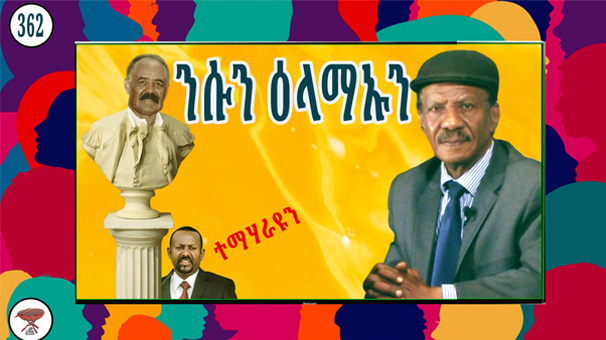
In 1971, a document titled Nehnan Elamanan (“We and Our Objectives”) surfaced. Authored by Isaias Afwerki and his associates, it was intended to justify their sectarian split from the Eritrean Liberation Front (ELF), which they characterized as a “jihadist” organization. The authors set out to create a new political-military formation aimed at mobilizing Eritrean Christian highlanders. Many Eritreans today trace the roots of the country’s enduring fragmentation and polarization to this document.
Nehnan Elamanan alleged that the ELF—described throughout as “jihadist”—had committed gruesome murders against Christians. More than four decades later, these claims still circulate as accepted truth among Isaias’ supporters. Over time, unsubstantiated allegations hardened into urban legends, were elevated into myth, and became embedded in collective memory. The result has been a deep and persistent mistrust among Eritreans. It is difficult to understand Eritrea’s cultural disharmony, sectarian suspicion, and regional frustrations without scrutinizing Nehnan Elamanan closely.
Despite its significance, the manifesto has largely escaped serious academic interrogation. Aside from a few isolated voices, little effort has been made to challenge its allegations. On the contrary, several self-styled Eritrean scholars have repeated its claims as if they were incontrovertible truths. Readers of the polished English translation are not entirely to blame, however, since the translation itself reflects ideological bias. The very title, Nehnan Elamanan, was rendered as “Our Struggle and Its Goals,” when the accurate translation is “We and Our Objectives.” This is not a semantic quibble. The manifesto is emphatically about “we.” Its authors openly declare, “Most, if not all, of us are Christian Highlanders,” a phrase laden with subliminal messaging directed at a specific constituency. It is not about the struggle in the national, inclusive Eritrean sense, but rather a sectarian clarion call aimed at a defined audience.
The manifesto continues to demand rigorous research and sober analysis, and we encourage qualified scholars to undertake that task. This article represents a modest attempt to contribute to that effort. By examining the evolution of Nehnan Elamanan, we aim to show how understanding Isaias Afwerki’s early political designs helps illuminate the logic of his later tyranny.
Because Nehnan Elamanan is widely believed to be Isaias’ own creation—his conceptual blueprint—a more fitting title might be “He and His Objectives.” The document planted the ideological seeds of the authoritarian system that now governs Eritrea and explains, in no small measure, how Isaias came to dominate the country’s political life.
This article will first introduce Nehnan Elamanan, then trace the circumstances of its emergence and its role in accelerating Isaias’ sectarian break from the ELF. It will also examine how he later joined two other splinter groups to form the EPLF—an organization he quickly brought under his control and which, after independence, evolved into today’s PFDJ. Finally, it will analyze how Isaias and his circle exploited the killing of Kidane Kiflu and Welday Ghidey—the only two casualties named in the manifesto and treated with particular sensationalism.
Nehnan Elamanan: The Eritrean Mein Kampf
Nehnan Elamanan was an effort to rewrite Eritrean history in service of Isaias’ ambitions. From the outset, the document clearly identified its intended constituency: the Christian population of the Eritrean Highlands. It sought to mobilize them by appealing to fear, suspicion, and grievance—distributing collective guilt for past political choices and calling on its audience to rally against a constructed “dangerous other.”
That “other” was Qiada Al’Amma (the General Command of the ELF), dismissively shortened to “Amma.” The document portrayed the General Command as politically unprincipled, militarily incompetent—“tebenja hizka m’kkublal… zttakhosu zneberu” (roaming aimlessly, firing guns at random)—and as an organization that used religion rather than nationalism as its organizing principle. It accused the ELF leadership of labeling Haile Selassie “kaffr” and the Eritrean struggle “jihad fi sebilli Allah” (struggle in the path of God), while allegedly looting Christian property.
The accusations escalated into caricature: the looting of 10,000 cows from Christian highlanders; purchasing houses in Sudan with the proceeds; drunkenness; serial marriages; and, when not engaged in such excesses, sharpening knives to slaughter Christians—“karatatom ksiHlu… nkrstyan kHardu.” The “other” was thus depicted as corrupt, bigoted, thieving, and murderous.
Having demonized the enemy, the document turned to flattering the “we”—consistently defined as Christian highlanders. It reassured them that any lingering guilt over the political choices of the 1940s was misplaced. Eritreans, it argued, were divided into two political fortresses: Christians favoring union with Ethiopia and Muslims favoring union with Sudan—an assertion that contradicts the findings of the UN Commission. It emphasized demographic dominance, citing the 1957 census to claim that “we” constituted 55.7% of the population, compared to 44.3% for “aslam hzbna.”
The manifesto insisted that Christian highlanders were no less nationalist or willing to fight for independence in 1961, blaming geography—not conviction—for their delayed participation. It claimed that bilingualism was imposed by the UN’s religious bias and that the ELF’s four-sector structure reflected ethnic divisions within its leadership. It legitimized the question, “why is a Muslim/Saho leading us?” and dismissed even Christian replacements as insufficient—“Hade se’Abi’om zkhone kristanay Haleqa” (a Christian chieftain who was one of them).
According to the document, reform within the ELF was impossible because “wedi dmu ney gedf nay e’mu” (bad habits are hereditary). With only two choices remaining—surrender to Ethiopia or be butchered by the ELF leadership—splitting became, in the authors’ view, unavoidable.
Page after page reinforced stereotypes of Muslim Eritreans as disorganized, barbaric, and inherently authoritarian: “Aslamay entenegese yHarrd e’mber neyferrd” (put a Muslim in authority and he becomes severe). The document succeeded. Four decades later, many Eritreans who know little of their own history remain convinced that the ELF was nothing more than a sectarian, murderous organization. Even foreign sympathizers absorbed the narrative, casually labeling the ELF a “Muslim organization.”
How did such a document come into being—and why was it so effective?
Part 2 will follow.

Awate Forum