

Authority, Responsibility, and Democracy from Below in Nilb Social Life
Traditional and agrarian societies have often addressed social, economic, and environmental problems through knowledge, relationships, and resources available within their own communities. This does not mean that such societies were self-contained, harmonious, or free of inequality. It means that the first response to a local crisis frequently arose from institutions people already recognised: kinship, customary authority, collective memory, and established places of gathering.
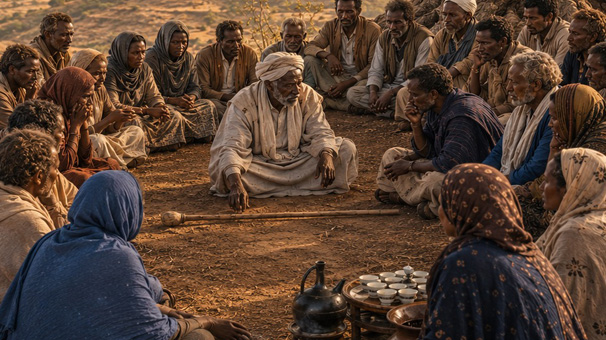
In Nilb social life, the tree, the stick, and the practice of shemglna offer an entry into this social world. A tree may provide the place where people assemble. A stick may make an elder’s authority visible. Shemglna may be a form of mediation associated with maturity, judgment, and responsibility. Yet none of these meanings should be assumed merely from the presence of the objects or the age of the person who carries them. Their significance depends upon the people gathered, the conflict that brought them together, and the trust, obligation, and inequality through which communal decisions are made.
The question, then, is not simply what the tree or the stick symbolizes. It is how authority becomes legitimate, how responsibility is exercised, whose voice enters the gathering, whose remains at its edge, and whether a community’s concern can travel upward and return with an answer. The following scene begins with the institution under its greatest pressure: a death has occurred, and the community must decide whether grief will be heard or permitted to produce another victim.
By the time the elder arrived, the two families had already taken their places at opposite edges of the gathering. One side had come carrying grief; the other had come carrying fear, shame, and the knowledge that grief might soon become retaliation. Between them stood relatives who belonged, through marriage and memory, to both sides. Younger men remained near enough to hear but not close enough to mistake their anger for authority. Coffee was being prepared beyond the formal circle. No one present could return the dead. The immediate question was whether another death would follow.
The elder did not create the gravity of the gathering by arriving with a stick. Death had already done that. Nor did the tree under which people assembled make their deliberation legitimate. Its shade offered a recognised place, but the meaning of the occasion came from those who had agreed, however reluctantly, to remain within speaking distance of one another.

An inquiry into Nilb community life begins with those who live within it, not with the tree as an isolated symbol, but with the people whose relationships made gathering necessary. The tree provided a place where a private injury could be recognised as a danger to the wider community. A killing involved a victim and a perpetrator, but its consequences could travel through families, relatives, neighbours, and future generations. The gathering enlarged the question. What had happened between two persons could no longer be left to two families if the likely result was a continuing cycle of vengeance.
The elder’s stick made authority visible, but visibility alone could not make authority effective. Those gathered had to recognise the person carrying it as someone capable of restraint, judgment, and responsibility. The decisive act might not have been raising the stick but placing it on the ground: a sign that the elder had entered not simply to command, but to hold open a space in which anger could be heard without being allowed to choose the next victim.
Here the idea of shemglna becomes more than a definition of age or status. It concerns the social recognition that a person may be trusted with matters whose consequences extend beyond the self. An older person does not necessarily possess such standing merely by having lived longer. Experience must become judgment; judgment must become conduct; and conduct must be recognised by others. A person known to inflame disputes, favour relatives, or humiliate the weak might carry a stick, but the object could not supply the trust that the person had failed to earn.
Authority in communal life is relational. The elder has standing only in relation to those who recognise that standing, and recognition carries an expectation. The person authorised to guide others is also obliged to protect the community from further harm. Authority that demands obedience while refusing responsibility empties the stick of its social meaning.
In a case involving death, that responsibility is severe. Representatives of the family of the person responsible may approach the bereaved family, acknowledge the loss, and ask that retaliation be suspended while the matter is heard. The approach itself cannot be treated as reconciliation. The bereaved may refuse to meet. They may regard an offer of compensation as an insult if it arrives before responsibility has been acknowledged. They may sit beneath the same tree without accepting the same account of what happened.
The gathering therefore does not eliminate conflict. It gives conflict a social form that may prevent it from becoming another act of violence. Different accounts can be heard. Customary principles and previous cases can be recalled. Money, livestock, property, or other historically recognised forms of restitution may enter the discussion. In some periods and localities, historical accounts may also mention marriage-related arrangements between families. Such practices cannot be generalised across all Nilb communities or carried uncritically into the present. They require documentation, localisation, and moral scrutiny, especially where the lives and consent of women are concerned.
Nothing offered in restitution can equal a human life. The value of customary reconciliation lies elsewhere. It may create a way for responsibility to be acknowledged, for the bereaved to be approached without further force, and for the wider community to declare that one death must not be permitted to recruit another. Reconciliation, in this sense, is not the erasure of grief. It is an attempt to prevent grief from being converted into inheritance.
The social life surrounding the formal discussion also deserves attention. Food and coffee may be prepared while the parties deliberate. These details should not be included merely to add cultural atmosphere. They reveal that mediation depends upon labour and relationships beyond the visible circle of speakers. If men occupied the formal space while women prepared what sustained the gathering, the analytical question cannot stop at who spoke beneath the tree. It must ask where women’s judgment entered the process, how information moved between domestic and public spaces, whether women could influence the terms offered by their families, and what occurred when they withheld agreement.
The evidence may show that women exercised consequential influence outside formal speech; it may instead show that their exclusion constrained both the process and its legitimacy. Neither conclusion should be assumed in advance. The important distinction is between visible participation and consequential participation. A history that records only the voices formally heard may mistake the boundary of the meeting for the boundary of political life.
Age and gender were not the only possible lines of inequality. Lineage, family standing, wealth, reputation, and proximity to customary or formal power may have shaped whose words carried weight. A communal gathering is therefore not democratic simply because several people are present. Presence is not equality, consultation is not consent, and social harmony may sometimes conceal the pressure placed upon a weaker party to accept what the stronger party calls peace.
These limits do not require us to dismiss the gathering. They require us to examine it more accurately. Customary practice may create an important space for consultation, mediation, and the prevention of retaliation while also reproducing hierarchy. Both realities can inhabit the same institution. The question is not whether the practice was wholly democratic or wholly oppressive. The question is how participation and exclusion were organised within it and whether those arrangements could be challenged.
This is why “democracy from below” is best used as an analytical lens rather than a historical title bestowed upon the past. A Nilb gathering beneath a tree was not a miniature parliament. It did not necessarily operate through elections, universal participation, constitutional rights, political parties, or modern rules of representation. Calling it democratic without qualification would collapse important historical differences.
Yet beginning with the institutions of the modern state can also make older and local forms of political action disappear. Political participation does not begin only when a ballot is cast. It can begin when people recognise a common problem, call others into discussion, formulate a position, entrust someone to speak, and demand that a distant authority respond. The phrase “democracy from below” directs attention to these social beginnings.
Four questions help test rather than merely celebrate the phrase. First, who can initiate discussion? If only established authorities may name a public concern, the gathering remains limited even when consultation follows. Second, who can speak and disagree? The presence of listeners cannot substitute for the ability to influence the outcome. Third, who carries the community’s position beyond the gathering? Representation requires more than personal standing; it requires some relationship to those in whose name one speaks. Fourth, does the answer return? A concern sent upward without an explanation brought back downward may turn representation into removal.
The movement from the tree to a person holding greater formal authority is therefore as important as the gathering itself. Community members may discuss a dispute, a family matter, a problem affecting several households, or an issue involving local administration. They may then recognise a representative to carry their concern forward. But the political meaning of that act depends upon answerability. Did the representative communicate the community’s position accurately? Could the community question what was said in its name? Did the authority respond? Did the representative return beneath the tree to account for that response?
Seen in this light, the tree is neither a romantic emblem nor an incidental backdrop. It marks a location from which a concern may enter public life. The stick does not prove the existence of legitimate authority; it makes visible a claim that must be sustained by conduct. Shemglna does not simply describe the old; it directs attention to the social process through which maturity and responsibility are recognised, tested, and sometimes withheld.
The killing case tests all three. The tree must hold people who have reason to avoid one another. The person carrying the stick must guide without pretending that authority can cancel grief. Shemglna must appear not as honour enjoyed by the elder, but as the capacity to bear responsibility when the community is closest to further violence.
Customary mediation and modern criminal justice should not be confused. A killing may require investigation and prosecution by the state. A communal process cannot automatically substitute for that legal obligation. It may address a different but related field of harm: the relationship between families, the danger of retaliation, the acknowledgement of loss, restitution, apology, and the possibility of living near one another after judgment. The existence of state law does not make those relationships disappear, just as the achievement of communal reconciliation does not erase the state’s duty toward the dead.
The broader meaning of the gathering becomes clearer when we move beyond the exceptional case of killing. Communities gather over ordinary disputes, family concerns, shared resources, social conduct, and matters they wish to place before customary or formal authority. The grave case reveals the institution under pressure, but it should not define the whole institution. What connects these gatherings is the recognition that some problems cannot be resolved by isolated persons because their consequences are already relational.
The central subject is therefore not the tree, the stick, or shemglna by itself. It is the community that gives each its meaning. But even “the community” must not be allowed to become another abstraction. It consists of people who enter the gathering unequally: one grieving, another accused, one authorised to speak, another expected to listen, one visible at the centre, another influencing the result from its edge.
To recover those people is not to abandon analysis. It is to make the analysis answerable to life. Authority can then be studied through the person expected to exercise it; exclusion through the person prevented from speaking; representation through the person entrusted to carry a concern; accountability through that person’s return; and social harmony through those asked to live with the settlement after the gathering ends.
Perhaps the most revealing moment comes after the formal words have been spoken. The elder retrieves the stick. The families rise without having forgotten what brought them there. Food is shared, or perhaps one party is not yet ready to share it. A representative prepares to take part of the matter to someone holding greater authority. Those who remain beneath the tree have not surrendered the question. They wait to learn not merely whether their concern travelled upward, but whether an answer will come back.
That return is where the possibility of democracy from below becomes visible. It does not lie in the tree as a metaphor. It lies in the continuing claim of ordinary people to name what affects them, to test the authority exercised among them, and to ask those who speak in their name: What did you carry from us, what answer were you given, and what happens now?
Note to the Reader
This paper is a work of fiction. Its setting, community, characters, and social world belong to the imagined world of Nilb, although the story draws inspiration from traditional laws, social practices, and forms of communal life found across parts of the Horn of Africa.
The customs represented here should therefore not be read as an account of any single community or as a claim that such practices are shared uniformly across the region. Traditions that appear similar may carry different meanings, functions, and histories from one community to another.
Nilb creates a fictional space in which these questions can be explored without asking any living culture to stand as the sole representative of the story. Where readers recognize echoes of their own traditions, those resonances are welcomed as part of the conversation the fiction hopes to open.
With that understanding, I invite you to enter the world of Nilb and read the story on its own terms.