
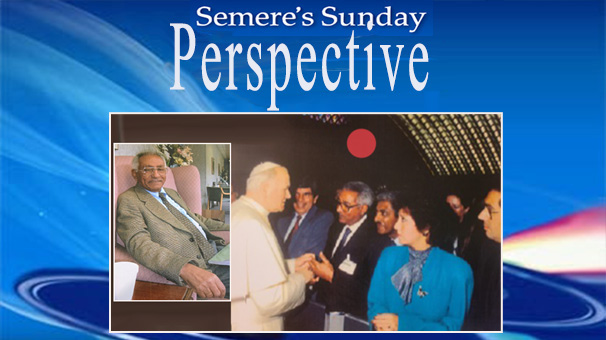

There is a Tigrinya saying I learned from my mother: “One who does not do small deeds should not dream of doing bigger things—ንእሽተይ ጽቡቕ ዘይገብር፡ ዓቢ ክገብር ኢሉ ኣይሕሰብ.” In truth, it is the small, consistent acts of goodness that shape our character and ultimately determine the destiny of a people. We are, after all, creatures of habit. As Proverbs 23:7 teaches, “For as he thinks in his heart, so is he.” Our character is not formed by external pressures but by the inner strength that allows us to say yes or no to those pressures. And Romans 12:2 reminds us: “Do not conform to the pattern of this world, but be transformed by the renewing of your mind.” The Quran reminds us that “everyone acts according to his character but only God knows well who is best-guided to the Right Path.”
These two principles—doing the small good things and refusing to conform to destructive patterns—find their clearest embodiment in one unsung hero I had the privilege of meeting: the late Tsegai Kahsai, a pioneer of Eritrea’s labor movement, its first labor union secretary, and one of the central figures in the national awakening of 1950s Asmera. He belonged to that rare circle of principled patriots who not only believed in the power of organized labor but understood its moral purpose. Among his closest friends was Woldeab Woldemariam, whom he and a handful of colleagues encouraged—indeed, pushed—to lead the Union. It was Tsegai Kahsai himself who formally nominated Woldeab to become its first president, a decision that helped shape the trajectory of Eritrea’s civic consciousness.
His life stands as a testament to the quiet, steady acts of responsibility that have preserved Eritrea’s national unity far more effectively than the loud proclamations of politicians or the slogans of movements. Those who knew him recall his frequent reminder that politics is simply the marketplace of ideas and talents—nothing more, nothing less. For him, politics was not a battlefield of identities but a disciplined space where citizens offered their best thinking, their best labor, and their best selves.
What made Tsegai Kahsai remarkable was not only his public role but his private ethic. He believed that unity is not maintained by grand speeches but by the countless small decisions individuals make to resist division, to reject easy cynicism, and to stand firm against the temptations of factionalism. In an era when many were swept into the currents of confessional and geographic polarization, he chose a different path—one guided by conscience, responsibility, and a long view of Eritrea’s future. His choices, often made quietly and without fanfare, helped inoculate our national fabric against the fractures that could have easily hardened into permanent fault lines.
Tsegai Kahsai represents the kind of Eritrean whose legacy we rarely celebrate: the principled bridge-builder, the steady hand, the man who understood that the health of a nation depends on the moral habits of its citizens. Through him, we are reminded that the guardians of our unity are not always those who shout the loudest, but those who—day after day—choose the harder right over the easier wrong.
A Life Shaped by Principle, Not Convenience
Forced into exile in the early 1960s because of his civic, national, and political activism, Tsegai Kahsai followed the path of Woldeab Woldemariam, Ibrahim Sultan, Idris Mohammed Adem, and other giants of our nationalist awakening. He was among the early architects of Eritrea’s struggle for self‑determination, serving in the PLF’s Foreign Office in Rome.
When the PLF split in 1976 into the Foreign Office (led by Osman Saleh Sabbe) and the Field Office (led by figures including Isaias Afwerki), Tsegai Kahsai faced a defining moment. Many of his highland comrades gravitated toward the Field Office. The split appeared to fall along confessional and geographic lines—an interpretation that, if accepted, would have been disastrous for Eritrea’s future.
Tsegai Kahsai refused to accept that narrative.
He believed deeply that Eritrea’s unity could not survive if its political movements were allowed to fracture along religious or regional lines. He understood that once such divisions are normalized, they become self‑fulfilling and nearly impossible to reverse. So he made a conscious, principled choice: he remained with the Foreign Office—not out of hostility to the Field Office, but out of a commitment to deny legitimacy to a dangerous and simplistic reading of the split.
This was not a grand gesture. It was a small good deed—a personal sacrifice made quietly, without fanfare, but with immense long‑term significance. And it invites a sobering reflection: imagine what Eritrea’s political trajectory might have been had the author of Nhnan Elamanan and the leaders of PLF 1, 2, 3 and those in the ELF possessed the same wisdom, restraint, and sense of responsibility. How different our history could have been if those entrusted with leadership had chosen unity over ego, principle over expediency, and the long view over the temptations of factional dominance.
This is why I have always believed that the most important quality of a leader is a deep sense of responsibility—the moral discipline to consider the consequences of one’s actions on the collective, not just on one’s faction or personal standing. Eritrea needs and deserves leaders who understand that responsibility is not a slogan but a posture of mind and heart. And when responsibility is paired with humility—the humility to listen, to self‑correct, to resist the seduction of absolutism—it becomes a transformative force.
It was this combination of responsibility and humility that guided Tsegai Kahsai’s choices. And it is precisely these qualities that must guide the next generation of Eritrean leaders if we are to heal, rebuild, and imagine a future worthy of the sacrifices made in our name.
A Quiet Bridge‑Builder in a Time of Fragmentation
When the Field Office established its own Foreign Office, one of the three leaders sent to Rome was Ambassador Haile Menkerios. Haile recalls how cooperative and generous “Aya Tsegai” was—offering every resource he could, sharing his networks, and supporting their work, even while remaining with the original Foreign Office. Because liberation movements were not legally permitted to open offices under their organizational names, the PLF Foreign Office in Rome had been registered under Tsegai Kahsai’s personal name. Remarkably, even after the PLF/EPLF consolidated its structures and took over the office, they continued to keep it under his name—a quiet testament to the trust he had earned and the indispensable role he played in anchoring Eritrean presence and continuity in Italy.
This was unity in practice, not in rhetoric.
Many in the PLF Foreign Office were unhappy with his decision to assist the Field Office, but his relationship with Chairman Sabbe was built on such deep trust and mutual respect that it never affected his role or standing. More importantly, Tsegai Kahsai became the person every Eritrean in Italy could count on—especially wounded tegadelti from both the ELF and the PLF/EPLF who came for medical treatment. He made himself available to help all Eritreans, regardless of political affiliation, because he understood that this is how national unity is preserved. His rationale was simple: no Eritrean should ever have to go to the Ethiopian Embassy if we could help it.
The Sabbe group, in fact, had a long-standing reputation for never discriminating among Eritreans who sought their assistance. This was true not only in Italy but across the Gulf countries as well. I personally know ELF and EPLF members who benefited from the protection and support of Sabbe’s network—people who never forgot that, whatever the political differences of the day, Sabbe’s group stood for Eritrean dignity above factional lines.
And while we are on this point, it is worth remembering that it was through the help of Osman Saleh Sabbe that the Tewahdo community in Khartoum was able to establish its own church. If this is not Eritrean unity in action—unity expressed through concrete deeds rather than slogans—then what is?
Years later, when Tsegai Kahsai was asked why he did not simply join the EPLF when the opportunity arose (he was asked to join), his answer was as simple as it was profound. He wanted to send a message that the 1976 split was not confessional, not geographic, and not a clash of identities. He wanted responsible Eritreans to see him—an Orthodox Tewahdo Christian from the highlands—remaining with the Sabbe group and understand that his alignment was rooted in principle, not in the politics of belonging. By staying, he refused to hand the enemies of unity an argument they did not deserve. He understood that once identity becomes the organizing logic of political choice, the nation fractures along lines that are almost impossible to repair. His decision was therefore not a personal calculation but a civic act: a deliberate refusal to legitimize the narrative that Eritrea’s struggle was divided between “this group” and “that group.” In doing so, he upheld a standard of national responsibility that still challenges us today.
He understood that headcount matters as much as platform. Symbolism matters. Presence matters. And sometimes, the most powerful act of resistance is simply refusing to move in the direction others expect you to.
The Deeper Lesson: Unity Is Preserved by the Quiet, Steady Hands
Eritrea’s national unity has never been maintained by slogans or declarations. It has been preserved by countless individuals like Tsegai Kahsai—people who refused to be boxed into confessional, ethnic, or regional pigeonholes; people who understood that once identity becomes institutionalized, it becomes weaponized.
A few, throughout our history, have tried to impose simplistic binaries on Eritrea. But the collective wisdom of our people—and the lived realities of our society—have consistently rendered those attempts null and void. It is this wisdom that I subscribe to and I want the next generation to preserve, cherish and protect.
The wise among us refused to give legitimacy to the lowest‑hanging fruits of division. They refused to let Eritrea become a mirror of the destructive identity politics that tore apart other nations. They chose the harder path: the path of nuance, responsibility, and quiet courage.
Honoring the Unnamed, the Unrecognized, the Unrecorded
I am certain there are many like Aboy Tsegai Kahsai—men and women who made deeply personal sacrifices to keep Eritrea’s unity intact. Their names may not appear in books, their stories may not be widely told, but their contributions are woven into the fabric of our national cohesion.
I had the privilege of meeting the late Tsegai Kahsai, and through honoring him, I hope to honor all the unsung heroes whose small good deeds kept our society healthy, resilient, and united.
Their legacy is a reminder that national unity is not built by grand speeches but by the quiet, principled decisions of ordinary people who choose responsibility over convenience.
In the early 2000s, when Ambassador Mohammed Nour Ahmed broke with the Eritrean regime, he arrived in the United States seeking counsel and companionship among his former colleagues. By a stroke of fortune, I had the privilege of hosting him for about a week. In that short time, I came to see what those who knew him well had long understood: he was one of the most decent Eritreans of his generation, a man whose quiet dignity was matched only by the depth of his love for his people and his country.
Before his assignment to China, the ambassador needed a pair of shoes worthy of the post. For that simple errand, he turned to his old friend, the late Tsegai Kahsai. They went together—two veterans of Eritrea’s long struggle—on what appeared to be an ordinary shopping trip. But the symbolism of that moment has stayed with me far more than the errand itself. It was a portrait of comradeship, of unity, of a purpose-driven life that had weathered many seasons. It was a reminder that nation-building is not only forged in the crucible of great events, but also in the small, faithful acts shared between principled men.
May we all, in our own time, go “shopping for shoes fit for the occasion.” For the long road toward national unity has never been paved by grand speeches or heroic myths alone. It has been built, step by step, by people like Tsegai Kahsai and Ambassador Mohammed Nour Ahmed—patriots whose humility, loyalty, and moral clarity laid the boundary stones of our collective path. Our responsibility now is both simple and sacred: not to move those stones, but to walk forward with the same steadiness, the same decency, and the same devotion to one another.
To contact the author: weriz@yahoo.com