

Today’s episode concludes the mini-series spanning episodes 349 to 354. I will place them all in one playlist for easy reference. And as the adage goes, sebaay klte neow nejew kbl mote—a person must finish what he starts. There are many topics awaiting us, especially the constant poking from Abiy Ahmed and his flamboyant but empty operatives.
Saleh was a fighter who joined our journey from Upper Barka. He was on his way to reunite with his unit in Kebessa—a region he had never visited. Coming from Kuluntebay, he had barely ventured beyond his village, and Kebessa was foreign to him. The more we advanced, the more disoriented he became.
His first shock came when he saw a guard perched on top of a hidmo, its mud roof covered with grass. It was nothing like the huts and tents he was used to. Having someone sit on top of that strange structure only deepened his confusion.
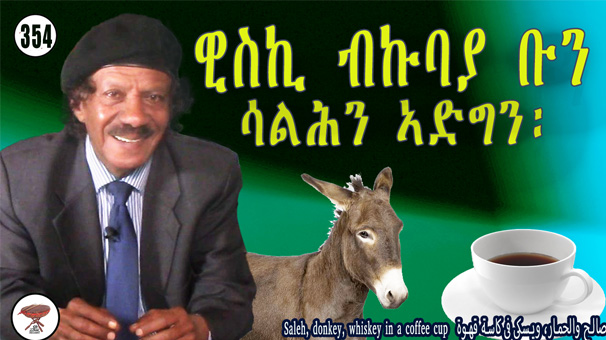
That night we spread hides on the floor inside the hidmo to sleep. Saleh lay there wide-eyed like an owl. Late in the night, the head of the household arrived, leading a donkey, and tied it near where we slept. Saleh jabbed me awake.
“What is this?” he whispered.
I groaned. “Don’t tell me you don’t know a donkey.”
Donate
“I know what a donkey is,” he replied. “But why is it inside the house with us?”
He couldn’t comprehend the Kebessa tradition of keeping certain animals inside the hidmo—just like someone today might keep a bicycle in their apartment. To Saleh, it was unthinkable.
“You mean we will sleep with a donkey in the same room?”
“Yes,” I said. “There’s enough space for all of us.”
“Yaray,” he muttered, “anaadi msl Adgi eesekb—by God, I will not sleep with a donkey.” He grabbed his kushuk and prepared to sleep outside. I warned him about the freezing cold, but he preferred risking sickness over sharing a room with the animal. He kept mumbling, “Are they serious? Sleeping with a donkey!”
Every fighter who moved between regions went through some cultural shock, some adapting quickly, others slowly, or never.
Realizing How Many Were Lost
In 1977, as I was returning from Kebessa after completing a second assignment, I was thinking of the long journey awaiting me. I wished I could pass though Keren to Hagat, but it was then under PLF control, and ELF fighters were not allowed in.
Luckily, at a teashop in Himberti, I ran into “Wedi Hagos,” a well-known PLF truck driver. We greeted each other warmly. He was headed to Keren and agreed to give me a ride—but could only drop me off at Halib-Mentel, 13 km short of the city.
I had known him some years ago when he started driving a truck to help his father, Aboy Hagos, my father’s favorite trucker. He used to haul goods for my father’s business, including Coca-Cola shipments to Humera. But our paths diverged: Wedi-Hagos joined the PLF, while I joined the ELF. And so, I could not enter my own hometown, where my family still lived.
When I climbed onto the truck, I found the late Dr. Eyob sitting on top of supply sacks. We reminisced about the battle of Afdeyu as we rode. At Halib-Mentel I said my goodbyes and began the long detour around Keren. If not for the restrictions, I would have reached Hagaz in under an hour. Instead, I had to hike eight more hours along a steep, rugged trail through Begu.
Not long after that, the PLF killed Dr. Eyob, accusing him of being “right-wing” or “left-wing” or whatever wing suited their needs—any excuse to end his life.
The Asmera Krar Boy
In 1991, after many years away, I visited Asmara. The city felt changed, though the old buildings remained worn and neglected. One evening, my late friend Shekheddin Yassin and I stopped at a bar on Croce Rosa Street. Several fighters, fresh from the field, were drinking. A 17-year-old boy was playing the krar (lyre) as young patrons gathered around him.
Then he sang a song one of them disliked.
“That’s a Derg song!” the young man shouted. The krar player ignored him. An argument erupted, and a fighter intervened. Upon confirming it was indeed a Derg-era melody, he grabbed the krar and smashed it over the boy’s head. The twisted strings dangled like a cartoon scene as random notes buzzed out. The boy cried, and the crowd pleaded with the drunken fighter until Shekheddin pulled him aside, reminding him, “He’s just a kid.” The boy left with his broken krar.
We walked to the Ambassador Hotel, where we stayed, and found several senior EPLF leaders sitting with coffee cups on their tables.
Whiskey in Coffee Cups
It was just a few weeks after independence. I didn’t know most of the leaders, but Shekheddin did, so we joined them. It took me a few minutes to realize the “coffee” they were drinking was actually whiskey, concealed in coffee cups—at least they felt the need to hide it.
Most fighters remained humble and disciplined, living a spartan life, so a little fun wasn’t inherently offensive. But the rigid public narrative portrayed them as flawless angels, creating a contradiction they were already failing to manage.
Mohammed Said Barih was among them; it was the last time I saw him since we stayed in Zagir clinic to be treated.
When I saw the concealed whiskey, I thought it was a good opportunity to raise my concern about the fighter who beat the krar-boy. I said, “It’s good you’re hiding the liquor, but I hope you set up military police to monitor the city and stop armed fighters from entering bars.”
All eyes turned toward me. Only one civilian objected, lecturing me about fighter discipline and battlefield fatigue. I explained, “Discipline disappears after a few drinks. An armed fighter with one cup too many can create tragedy—and damage the euphoria of independence.”
Some seemed offended; others, like Haile Derou’e, went into deep thought. Known for his calm persuasion, Haile defended me and promised to raise the issue with his colleagues, the leaders of the EPLF.
I was optimistic then, believing the EPLF would evolve into something better. I was mistaken. The diplomatic smiles soon faded, replaced by militarism. And Eritrea still lives with that legacy.
Still, I cajole and advise them every now and then. But the more I do that, the more rigid they become. It’s like kneeling under a mountain and praying for it to give way. That will never happen. An Eritrean saying goes, “Habits don’t change, and a mountain never leave its place.”