

What Another Eritrea Is Worth, and Who Pays for It
This essay asks that Eritrean political change be examined not only as a moral demand but as a decision taken under uncertainty, of the kind that can be broken into its parts and considered one part at a time. The single demand around which our opposition has organized itself for decades contains four separate questions: what the political order that follows is likely to be worth, how uncertain that order is, what the passage to it costs, and who pays. The first three can be worked on from outside the country and have been largely neglected. The fourth belongs to the people living inside it and cannot legitimately be settled by anybody else.
What does a man in Asmara already know how to do?
A young man in Asmara is deciding whether to leave the country, and although nobody has taught him how to think about it, and although the whole of the reasoning will happen in his head and never be written down anywhere, he is performing one of the harder calculations a person is ever asked to perform, which is to weigh a future he cannot see against a present he will not go on tolerating, using information supplied largely by people who have reasons of their own for telling him what they tell him.
He asks himself what life would be like on the other side, and he does not picture only the best version of it, because he knows people who reached Europe and found work and he knows people who reached Libya and did not come back. He asks how sure he can be, and the honest answer is not very, because the route changes, the borders change, and the people advising him are not disinterested. He asks what the attempt would cost him, counting money, the risk of being shot at the border, prison if he is caught, and what happens to his mother if he does not arrive. And then he asks the last question, which is whether he can bear that price, and this is the question nobody else can answer for him, though a great many people will offer.
He is weighing four things at once: how good the outcome is likely to be, how uncertain it is, what the attempt costs, and whether he can pay. That is the whole of what economists mean by a decision under uncertainty, and he does it without an equation, in the dark, with poor information.
Donate
Political change is the same kind of decision, made by the same people, about the same country, and with even less information available.
Everything our opposition produces, whether it comes from a party platform, a television panel, a website comment, or a Sunday demonstration in a European city, eventually arrives at the same sentence, which is that the regime must go. I have no argument with the sentence. Three decades of indefinite national service, imprisonment without charge, closed politics and economic decay stand behind it, and Eritreans hardly need another essay establishing that the present system is intolerable, least of all from someone living where the electricity works. But the four questions the young man asked himself are folded inside that sentence, and we have never taken the trouble to pull them apart. We have been busy instead with a fifth question, which is whether the present government is bad, and that one was answered long ago by the people who live under it.
So the four are these. What is the political order that follows this one likely to be worth, counting not the best version we can imagine but the whole spread of versions that could plausibly arrive? How confident can anyone be in that estimate, in a country whose people have no living experience of open national political competition? What does the passage from here to there cost, and in what currency is the cost paid? And who, exactly, is the person paying it?
Once they are separated, something becomes visible that the single sentence had been holding out of view. The first three describe conditions that those of us outside the country can work on directly, with resources we already have and without anyone’s permission, and we have spent years leaving all three more or less untouched, on the assumption that the fourth was the only one that mattered. The regime, meanwhile, has been working on the first three without interruption. The fourth belongs to the people living inside Eritrea, whose lives are the currency in which any answer is denominated, and it is the one thing that cannot legitimately be settled by anybody else.
Almost the whole of our rhetoric consists of reaching for it anyway.
I call this framework the Priced Alternative, because the name is the argument in miniature. We have spent three decades demanding an alternative that nobody has priced.
At the outset I should say what the framework does not do. It does not tell any Eritrean whether or when to act, it does not predict how the present government ends, and it does not replace the moral argument against dictatorship, which was settled long ago and needs no further help from me. It also begins by treating political change as one man’s decision, which is only part of the truth, since the price of acting falls sharply when many people act at once. I take that up below, because it turns out to strengthen the argument rather than weaken it.
What is another Eritrea actually worth?
Our political language assigns enormous value to removal, and it is not hard to see why. The government falls, the prisons open, the exiles return, political organizations come back into the country, and a transition begins. All of that matters, and none of it should be treated lightly by anyone who has waited for it.
But removing one political order and building another are different achievements, and our language does not distinguish between them.
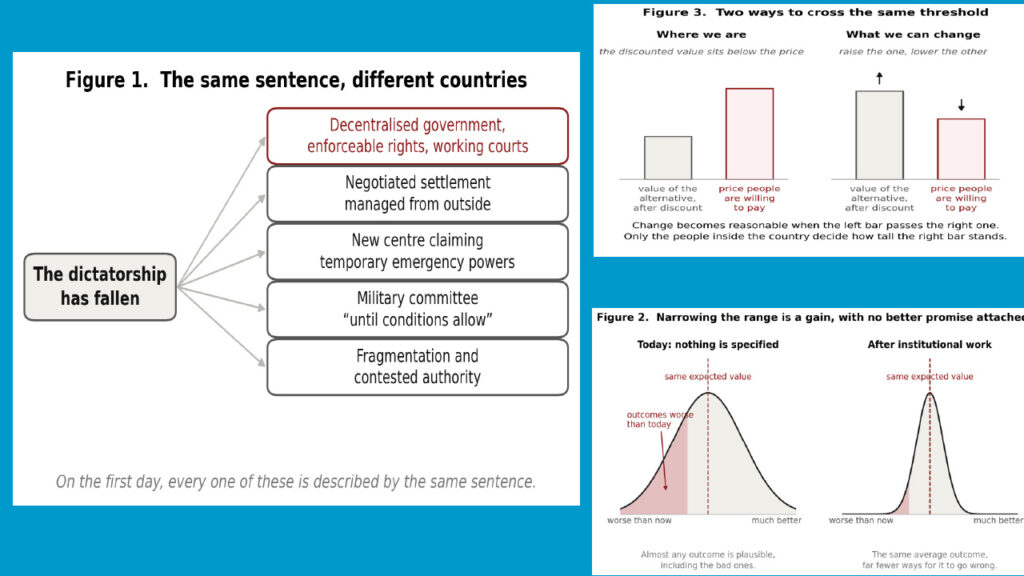
Consider two mornings. In the first, the present government has gone and the country moves toward enforceable rights, functioning courts, security services answerable to civilians, real authority in the regions and firm limits on what the executive may do. In the second, the government has gone and another centralized authority has taken its place, asking for patience, declaring an emergency, and postponing political competition until the situation has been stabilized, which is a condition it will define for itself and can therefore postpone indefinitely.
On the first day, both are described by the same sentence. The dictatorship has fallen.
Removal opens a range of futures. It does not select one of them. And what a political change is worth is not what the best of those futures is worth, but an average across all of them, with each counted according to how likely it is. Suppose, using invented numbers purely to show the shape of the arithmetic, that a transition had one chance in four of producing a genuinely accountable government, which we might score at a hundred, and three chances in four of producing another centralized authority under a new name, which we might score at twenty. The value of the change is not a hundred. It is forty, because the hundred arrives only a quarter of the time.
Our broadcasts quote the hundred. They do it so consistently that the habit deserves a name. We describe the best future we can imagine and then treat it as the thing that removal delivers.
This is also why the value of the future has to be raised before a transition rather than celebrated after one. Afterward is too late, because afterward the person holding the guns is writing the definition, and every argument about what the new order should be will be conducted in a country where one party to the argument commands the army.
Raising that value means answering questions that sound smaller than overthrow and are not. What would a local government actually control, and who writes and audits its budget? What happens when the police detain a person unlawfully, and which institution can compel his release? How long may national service last, and who enforces that limit against the government itself? How are judges selected, and by whom can they be removed? How are land disputes settled? What may a transitional authority do, and what must remain permanently outside its reach, including in an emergency of its own declaring?
Someone will reply that Eritrea already has a constitution, that opposition organizations have charters and political programs, and that transition proposals have been written many times over. All of that is true, and none of it is what I am describing.
A political arrangement does not become publicly meaningful because it exists in a document. It becomes meaningful when ordinary people know roughly what it says, argue about it, compare it against alternatives, and begin to expect that whoever governs them next will be held to it. The difference is the difference between a rule that exists and a rule that people are watching for. Our constitution has sat unimplemented since 1997 without producing the smallest inconvenience for anyone in power, and it has done so precisely because it never became something the public was watching for.
Why does uncertainty behave like a cost?
It is worth pausing on this, because it is the part of the argument most likely to be mistaken for a comment about morale.
Imagine two futures promising roughly the same benefits. In the first, the rules of transition are clear, the main actors have agreed in advance on limits they will observe, the administration continues functioning, the army’s role is defined, and there is a timetable for the transfer of authority. In the second, everyone has simply promised that things will become democratic once the regime is gone.
A reasonable person values the second less, even though its promise is identical, and the reason is that a promise with no mechanism attached can end in many more ways, several of which end with the person weighing it in a prison. Uncertainty is not a feeling about the future. It is a property of the situation, and it lowers the worth of an offer in exactly the way a buyer discounts a house that may or may not have a clear title.
Notice what this means. The range can be narrowed without anyone promising anything better than before, and narrowing it is a real gain even though the average has not moved.
The range is very wide in Eritrea. The state is deeply militarized, authority has been centralized for as long as anyone can remember, the opposition carries disagreements that are decades old, the region is unstable, neighboring governments have interests of their own in the outcome, and almost nobody now living has been through an open national contest for power. An Eritrean considering political change is therefore not choosing between dictatorship and democracy, whatever our slogans suggest. He is choosing between one terrible known condition and a spread of unknown ones, some of which would be far better than what he has and some of which would be worse.
That spread is not weighed the same way by everybody, and this is where our language turns cruel without noticing. Consider two men offered the same gamble. The first has savings, a second passport and a brother abroad, and if the gamble goes badly he recovers. The second has no savings, three children and no way out of the country, and if the gamble goes badly he does not recover at all. It would be a mistake to call the second man a coward for refusing what the first man accepts. He is applying a higher weight to the same uncertainty, and he is applying it correctly, because the same bad outcome costs him incomparably more.
His caution is not a defect of political consciousness. It is an accurate reading of a wide range by a person who could not survive the bad end of it, and any strategy that treats that caution as the main obstacle has misunderstood the problem it is trying to solve.
What do we get wrong about sacrifice?
There is a further problem buried in our political language, and it runs in one direction only.
Eritrean political history gives sacrifice an enormous moral weight, for reasons nobody needs to have explained to them. The armed struggle demanded endurance and loss on a scale that shaped everything afterward, and sacrifice came to stand for seriousness, dignity and the refusal to submit. But that inheritance produces a confusion, which I would call a sacrifice-value inversion, in which the fact that something cost a great deal becomes the evidence that it must have been worth a great deal.
Sacrifice does not create political value. It is a cost, and it sits with the other costs.
Death does not improve the government that follows it, destruction does not make democracy more democratic, and the number of people who died for an objective tells us nothing about whether the order eventually produced was worth what they paid for it. This seems obvious when stated plainly, and yet our political language works steadily in the other direction, so that expensive strategies appear more serious than cheap ones, restraint reads as weakness, and the willingness to pay a terrible price is taken as proof of commitment rather than as the price it is.
The useful question, then, is not how much sacrifice we can inspire. It is how much unnecessary cost can be stripped out before anyone is asked to pay anything at all. Can the institutions survive a transition? Can disagreements among opposition organizations be settled now, while none of them holds any coercive power and agreement is therefore cheap, rather than later, when it will not be? Can the public be given a clear distinction between removing a government and destroying a country?
Every reduction of that kind moves the same threshold our exhortations are trying to move, and it moves it without asking a single person to become more heroic than he already is.
What does it look like written down?
Three quantities have now been described in ordinary words, and they are all the argument requires. The worth of political change depends on how good the order that follows is likely to be, minus what has to be paid to reach it, minus a further reduction for how little anyone can be sure of what will actually arrive.
If it helps to hold them apart on the page, they can be written as:
Net Value of Change = Expected Value of the Future − Cost of Transition − Discount for Uncertainty
Or in short form:
NPV = E(Vf) − C − λU
E(Vf) is the average worth of the futures removal that could be produced, each counted by how likely it is, which is the forty rather than the hundred. C is the cost of the passage, paid in imprisonment, disappearance, ruined livelihoods, displacement, disorder, injury, and in many cases life itself. U is how wide the range of possible outcomes is, and λ is the weight a particular man puts on that width, which is why the man with three children and no passport is not being irrational when he refuses what his cousin in Frankfurt accepts.
The line proves nothing and predicts nothing, and nobody is being asked to believe a number inside it. It is a device for holding four things apart that our ordinary language keeps folding into one, and a reader who skips the notation entirely has not missed a step of the argument.
What the notation does show is that three of the four quantities have no person attached to them. They are properties of the situation, and they can be worked on by anybody, from anywhere, including from a studio in Frankfurt.
The fourth has a person attached to it, and that changes everything about who may touch it.
Who decides whether the price is worth paying?
Economists call it willingness to pay, and it means the most a person will give up for something he wants. In ordinary life we meet it constantly. A man may want a car very much and still refuse it at a certain price, and nobody concludes from his refusal that he does not understand cars. Here the currency is not money but prison, exile, lost work, injury, the safety of one’s children and the possibility of not surviving, which makes the concept more serious but not more complicated.
The rule that follows can be stated in one line. Political change becomes reasonable for a person when the value of the alternative, after he has discounted it for everything he cannot be sure of, rises above the cost he is willing to bear.
I call that the Bearer’s Threshold, and the word bearer is the whole of the point.
Nobody outside the country can set that threshold on his behalf. And yet a great deal of our rhetoric consists of trying to set it. Wake the people. Mobilize them. Raise their consciousness. Tell them not to be afraid. Look carefully at the structure of that relationship, because it is the structure and not the sincerity that matters: one party recommends a course of action, and a different party absorbs its consequences. The activist abroad faces almost no personal cost from what he is recommending, while the man inside the country is weighing imprisonment, disappearance, the safety of his children and whether his family eats next month. When the person setting the threshold and the person paying at it are not the same person, the argument is not leadership, whatever its intentions. It is a transfer of risk conducted in the language of conviction.
What those of us outside can legitimately do is change the terms of the decision rather than the person making it. We can make the alternative more valuable. We can make it more credible. We can make the passage less dangerous. And then the judgment belongs to the people who will live with the result, taken on better information than we have so far given them.
What is the regime actually doing?
This framework explains something about the government’s survival that our moral vocabulary cannot.
A government does not have to persuade anyone that it is good if it can persuade them that the alternative is dangerous, and ours has understood that for a very long time. It raises the cost of political action by criminalizing organization, so that the first step is priced beyond what most families can pay. It widens the range of outcomes by destroying independent institutions and preventing any credible alternative from taking shape, so that nobody can say with confidence what would follow. It raises the weight people place on risk by keeping regional collapse permanently in view, so that every unknown resembles a neighboring catastrophe. And it works directly on the value of the alternative by presenting every possible successor as chaos, foreign manipulation, fragmentation or another war.
Read those four sentences again against the quantities. They are the same ones, worked in the opposite direction, deliberately and without pause.
A government that cannot make itself attractive can still make the exit expensive, unclear and frightening, and that is a coherent strategy of survival rather than a failure of persuasion. Which means the contest between us is not only over whether the government is intolerable, a question that was settled without our help. It is a contest over the value, the clarity and the price of the alternative.
The regime has been fighting it on all four fronts. We have been fighting on the one front it conceded at the beginning, and pushing on the one variable that was never ours.
Is this an argument for waiting?
It would be fair to object that everything so far has treated political change as one man’s decision, weighed alone in his own house, when in fact the price of acting depends almost entirely on how many other people act at the same moment. One person distributing a leaflet in Asmara is a prisoner. A hundred thousand people in the streets of Asmara are a government’s problem. The cost is therefore not a fixed number attached to an action. It moves with the number of others taking the same action, which means that what looks like a stable and hopeless situation can turn over very quickly once enough people move together.
This is well understood outside our politics. Mark Granovetter described social action in terms of thresholds, where each person’s willingness to act depends on how many others have already done so, and showed that populations with almost identical private views can produce completely different outcomes depending on how those thresholds happen to be distributed. Timur Kuran extended the point to authoritarian states, arguing that people who conceal their real opinions produce a public silence that misleads everyone, including themselves, until some small event reveals that the silence was never agreement, at which point change arrives with a speed that surprises even the people producing it. Susanne Lohmann traced this in Leipzig, where a sequence of Monday demonstrations grew until the East German government discovered that its apparent stability had been an artifact of everyone’s uncertainty about everyone else.
Two things follow, and neither is a reason to wait.
The first is that a cascade of that kind cannot be scheduled, which is precisely why the preparation cannot be scheduled either. Whatever exists at the moment the silence breaks is what the country will have to work with, and if nothing exists except a set of organizations claiming succession, then the arrangement that follows will be chosen by whoever is best armed when it happens. In 1991 what existed was one organization with an army, and we have spent thirty-five years living inside the consequences of that.
The second is that simultaneous action requires shared expectation. People move together when each of them believes the others will move, and belief of that kind is built out of things that are publicly known: an agreed set of conditions, a described alternative, procedures that everyone knows everyone else has heard of. Those are not substitutes for collective action. They are the material out of which the common expectation that makes collective action possible is assembled, and they are the part of the work that can be done from abroad while the rest cannot.
So the argument is not that Eritreans should wait until the alternative is perfected. The interval is passing whether we use it or not. The argument is that we have been spending it on the one variable that was never ours, and that the other three are sitting there untouched, available, and cheap.
Is this a cold way to think about it?
I expect that objection, and I think it has the matter backwards.
The moral framework asks Eritreans to accept an unspecified risk on the strength of a promise, and when they hesitate it calls the hesitation fear. The framework under discussion, however, asks them to weigh a described risk against a described alternative, and when they hesitate, it treats the hesitation as reasoning. One of those approaches treats the public as an instrument of history. The other treats it as the party with the standing to decide, which is what it is.
None of this replaces the moral case. The moral case is what established that this order is worth leaving, and it did its work. The arithmetic only asks the question that comes after it, which is whether we have done anything to make the leaving survivable, and on that question our record is much worse than we admit.
What should we actually do?
The greatest political resource Eritreans outside the country possess is not military and not organizational. It is communicative. We have television, radio, YouTube, websites, professional expertise, public forums and the freedom to argue about questions that cannot be raised aloud inside the country.
Most of that capacity has been spent, understandably, on establishing what is wrong with the present government. That work still matters and should continue, because abuses should be documented, prisoners should not vanish from public memory, and new events should be reported. But one more denunciation adds very little now, for a reason that has nothing to do with morality. Information changes a decision only when it changes somebody’s estimate of something, and Eritreans hold the best possible evidence about the value of the present order, which is their own lives. Telling a man in pain that he is in pain does not help him choose a treatment.
So I would propose six changes, and I have put them in the order in which they would have to be made, because each one depends on the one before it.
The first is to describe the alternative concretely, in public. Not in charters that nobody reads, but on air and in print and in argument, repeatedly and in detail. What local authorities would control. What limits national service and who enforces the limit. How judges are appointed and removed. What a transitional government may never do. The more concretely an arrangement is described, the fewer gaps a listener has to fill with his own fears, and detail that reads as pedantry in an essay does real work in a public trying to picture what it would be agreeing to. A person cannot want an arrangement he cannot describe. This comes first because nothing else on the list is possible without it: an organization cannot promise to respect an arrangement that has not been described, and a public cannot expect one either.
The second is to ask for pre-commitments while they are still cheap. Once the arrangements are on the table, every opposition organization can be asked to state publicly what it will not be entitled to do later. A fixed end date for any transitional role. No automatic claim to office arising from armed participation. Agreed rules for the constitutional settlement. To see why such statements carry weight, think of the old rule for dividing something between two children, where one cuts and the other chooses. The cutter has every reason to cut evenly, not because he has become fair, but because he does not know which piece he will end up with. Rules agreed before anyone knows his own position tend to be better rules, and they are believed more readily for the same reason. Every one of those commitments is cheap to make today and expensive to make later, which is exactly why today is when they should be asked for. Publish who agrees and who declines, since a refusal is information too, and arguably the more useful kind.
The third is to say plainly what survives. Hospitals, schools, the civil service, the municipalities and the technical institutions do not have to fall with a government, and saying so publicly and repeatedly costs us nothing. Much of what people dread about transition is not the absence of a president but the absence of a salary, a clinic, a school, electricity and ordinary public order. When we fail to make that distinction, the fear of losing those things attaches itself to the idea of change. This follows from the first two, because once there is a described arrangement and a set of commitments about political power, it becomes possible to explain what is not at stake in a transition, which is most of the ordinary machinery of daily life. Until then, the regime’s warning about chaos stands unanswered, and our silence has been doing its work for it.
The fourth is to build the Pledged Public. The idea rests on something we tend to forget, which is that no government rules mainly by force. It rules because most people, most of the time, treat its instructions as instructions rather than as threats, and that habit of recognition is granted by the public rather than seized by the state. The Pledged Public is the proposal that citizens agree, in advance and in public, on the conditions any government must meet before it receives that recognition. It does not choose a government and it does not compete for power. It withholds recognition from anyone who takes power outside the agreed procedures, and in doing so it closes off one particular branch of the future, which is the branch where whoever reaches Asmara first declares himself the government because he is there and armed. This is fourth rather than first because a public cannot pledge to conditions that do not yet exist in any specific form.
The fifth is to stop treating other people’s courage as the main variable. By this stage there is something better to do with our platforms than campaign for the willingness of people whose risks we do not share, and the argument for leaving that variable alone has become practical as well as ethical. The terms of their decision will have improved. The decision itself was never ours.
The sixth is to test everything we publish by asking what it changed. Did it raise the value of the alternative, narrow the range of outcomes, or lower the price of the passage? If it did none of the three, we should be honest about what political work it performed, because producing the feeling of activity is not the same as producing an effect. This one comes last because it is the only way the first five survive contact with our habits.
None of this requires unity, permission, or a change of regime, and all of it could begin this week.
We have spent three decades explaining why the present is unacceptable. The task that remains is to make the alternative valuable enough, clear enough and safe enough that Eritreans can make their own judgment about the price, which is theirs to make and has always been theirs.
So we might stop asking whether people are finally ready to sacrifice, and start answering the questions that come before sacrifice.
What are you offering? How sure can I be? And what will it cost me?
Works consulted
Listed with a note on what each contributes.
On the decision itself
Adam Przeworski, Democracy and the Market: Political and Economic Reforms in Eastern Europe and Latin America (Cambridge University Press, 1991). The central treatment of democratization as a process whose outcome is uncertain by design, and of why actors accept institutions that may produce results they dislike.
Gordon Tullock, “The Paradox of Revolution,” Public Choice 11 (1971). On the calculation an individual makes about participating in political change, and why the arithmetic so rarely favours participating.
Daniel Kahneman and Amos Tversky, “Prospect Theory: An Analysis of Decision under Risk,” Econometrica 47, no. 2 (1979). On why a possible loss weighs more heavily than an equivalent possible gain, which is much of what lambda is doing.
Erica Chenoweth and Maria Stephan, Why Civil Resistance Works: The Strategic Logic of Nonviolent Conflict (Columbia University Press, 2011). On the costs attached to different methods of resistance and the outcomes associated with each.
On publics that appear quiescent and then are not
Timur Kuran, “Now Out of Never: The Element of Surprise in the East European Revolution of 1989,” World Politics 44, no. 1 (1991), and Private Truths, Public Lies: The Social Consequences of Preference Falsification (Harvard University Press, 1995). On concealed preferences and the sudden collapses they make possible.
Mark Granovetter, “Threshold Models of Collective Behavior,” American Journal of Sociology 83, no. 6 (1978). On why the cost of acting depends on how many others are already acting.
Susanne Lohmann, “The Dynamics of Informational Cascades: The Monday Demonstrations in Leipzig, East Germany, 1989-91,” World Politics 47, no. 1 (1994). The Leipzig case in detail.
On commitment made in advance
Thomas Schelling, The Strategy of Conflict (Harvard University Press, 1960). On commitments that bind the party making them, and on the expectations that let people coordinate without communicating.
Jon Elster, Ulysses and the Sirens: Studies in Rationality and Irrationality (Cambridge University Press, 1979). On why an actor might rationally limit his own future options.
Douglass North and Barry Weingast, “Constitutions and Commitment: The Evolution of Institutions Governing Public Choice in Seventeenth-Century England,” Journal of Economic History 49, no. 4 (1989). On institutions as the mechanism that makes a ruler’s promises believable.
John Rawls, A Theory of Justice (Harvard University Press, 1971). On rules chosen without knowledge of the position one will occupy under them.
On transition and recognition
Guillermo O’Donnell and Philippe Schmitter, Transitions from Authoritarian Rule: Tentative Conclusions about Uncertain Democracies (Johns Hopkins University Press, 1986). On pacts, guarantees and sequencing during transition, including the guarantees offered to those who might otherwise obstruct it.
Margaret Levi, Consent, Dissent, and Patriotism (Cambridge University Press, 1997). On compliance as something granted conditionally by citizens rather than simply extracted by states.