
Horn of Africa’s Tom and Jerry Show
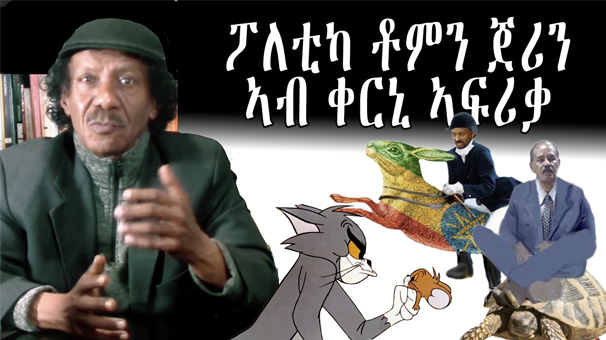
Eventful weeks, months, and years have passed, and we will receive 2026 with the same boringly repetitious situation of the world. The Tom and Jerry shows are many and everywhere, but I will focus on the political Golden Globe–winning region: the blessed—and at the same time cursed—Horn of Africa.
In recent months, Somaliland produced several episodes starring its restless leaders. Then Abiy Ahmed insisted on being a producer himself, assembling extras that even Disneyland could not gather. Somaliland’s leaders promptly fired Abiy and took charge. For a few days, we have been watching the latest reruns, packaged as novelty but unmistakably familiar.
I used to watch Tom and Jerry for many years until unimaginative, stale remakes took over. If Disney wanted to revive the show with a twist, I could write hundreds of episodes—not the innocent mischief of the original cartoon or the elegance of The Pink Panther, but darker, realistic stories. Stories about the legacy bearers of savage rulers in suits—or in safari gear and sandals—and, most of all, warrior leaders who decorate their shoulders with crown corks and improvised stripes of gallantry.
That was the bird’s-eye view. Now let us descend into the details.
The Arab–Israeli conflict is as old as modern political memory. But why are Eritrea and Ethiopia dragged into its orbit?
A day after Israel was declared a state in May 1948, a major confrontation erupted between Arab forces, led by Egypt, and Israel. In that war—known as the Nakba, or catastrophe—more than 700,000 Palestinians living under the British Mandate were displaced and turned into refugees. Hundreds of villages were emptied or erased. The fighting ended a year later with armistice agreements, but the wound never healed.
War returned in 1956 after Colonel Gamal Abdel Nasser overthrew King Farouk and nationalized the Suez Canal. Israel, supported by the United States, Britain, and France, confronted Egypt. Nasser aligned himself with the Soviet Union, which later built the Aswan High Dam on the Nile River—a project whose strategic implications made Nile waters a permanent source of tension between Egypt and Ethiopia.
Years of attrition followed. Between 1967 and 1970, Israel launched a preemptive attack against its neighbors, occupying the Sinai Peninsula, Gaza, the Golan Heights, and East Jerusalem, which had been under Jordanian control. The Suez Canal was closed, amplifying economic and political shockwaves across the region.
Nasser championed decolonization and became a patron figure for liberation movements. Rebels across Africa and the Arab world found in him protection, propaganda platforms, and educational opportunities. His image grew not merely from military confrontation but from symbolic leadership during a time when colonial empires were collapsing.
The 1973 war, under President Anwar al-Sadat of Egypt and Hafez al-Assad of Syria, altered the landscape. Egypt regained control of the Suez Canal; Israel retained the Golan Heights, which remain occupied to this day. The war culminated in the Camp David Accords, brokered by President Jimmy Carter, leading to a peace treaty and Israel’s withdrawal from Sinai. Relations between Egypt and Israel normalized, but accusations of proxy wars and hidden hands began to surface—particularly from Ethiopia.
The two countries appeared to maintain normal diplomatic relations, yet mutual suspicion never faded.
Egyptian Involvement in Yemen
In the early 1960s, North Yemen was ruled by a traditional monarchy, while the South was under British colonial rule. These were the golden years of Aden, a thriving port that attracted traders and businessmen from across the Red Sea, including Eritreans.
Egypt intervened militarily in Yemen’s civil war between 1962 and 1970, siding with republican forces against royalists. It was the height of the Cold War, and Yemen became another battlefield in a global contest. The intervention drained Egypt militarily and politically, but its legacy lingered.
Decades later, Yemen was unified in 1990 under Ali Abdullah Saleh. The unity proved fragile. Fragmentation returned, and Egypt remained—directly or indirectly—a regional actor.
Ethiopian–Egyptian Relations: Eritrea in the Middle
Officially, Ethiopia claimed neutrality in Arab–Israeli conflicts. Unofficially, popular sentiment leaned heavily toward Israel. The Abyssinian Tewahedo Church draws deeply from Old Testament tradition, embracing the Tanakh alongside the New Testament. Texts such as the Kebra Nagast—treated in practice as sacred—reinforced a political theology that shaped Ethiopia’s imperial identity.
Haile Selassie ruled as the “Lion of Judah, King of Kings of Ethiopia.” That symbolism was not decorative; it molded political psychology. It still does.
This psychological framework complicates relations with Egypt, especially after Ethiopia began constructing the Grand Ethiopian Renaissance Dam. Since Abiy Ahmed started dreaming aloud about ports and maritime access, Eritrea has been recast as a convenient villain in an orchestrated propaganda campaign. Even formerly silent elites now display Red Sea hysteria, as if bitten again by an old hegemonic bug.
The sacrifices Eritrea made to gain independence from Ethiopia are not matters of opinion. They are matters of record—acknowledged by the United Nations, confirmed by a UN-supervised referendum, and accepted by any honest observer. Yet a revisionist narrative has emerged among sections of the Ethiopian elite, claiming that Eritrea’s liberation struggle was an Egyptian creation.
What explains this narrative? Prejudice—particularly against Muslims—concealed beneath clever rhetorical veils. Strip away the language, and the bias remains exposed.
Despite long-standing religious ties between Ethiopia’s Tewahedo Church and Egypt’s Coptic Church, Ethiopia treats Egypt as a strategic rival. The Nile dispute is layered atop older racial memory and unresolved 19th-century conflicts that continue to shape the Abyssinian psyche. Ethiopian elites exaggerate Egypt’s support for opposition movements, including Eritrea’s during its years under Ethiopian occupation.
Some of the Elite’s Urban Legends
To this day, some Ethiopians claim Egypt supported Somalia during the 1977–78 Ogaden War as part of a strategy to weaken Ethiopia—and that the same tactic was applied to Eritrean liberation movements. By that logic, should one argue that the UAE, an Arab country, supports Ethiopia today in order to weaken the Horn of Africa?
The Nile issue itself has been handled amateurishly and irresponsibly. It was inflated into an existential threat, particularly after the Morsi era, when Egyptian media turned water politics into daily hysteria. Egyptians were told they would go thirsty; warlike rhetoric followed. Such damage is not easily reversed. It is unbecoming of two major states to conduct themselves as if they were quarrelsome street gangs.
The Arab Spring triggered a realignment of power across the region. Yemen fractured once again. The Houthis seized Sana’a; Saudi Arabia, partnered with the UAE, launched military campaigns citing Iranian involvement. Yemen ended up with two governments—one operating from Saudi Arabia, another under UAE influence in the South. Egypt aligned itself with the Saudi-backed “legitimate” government. The Red Sea became another crowded theater of recycled conflict.
The Houthis later disrupted Israeli shipping; Israel responded with brutal air raids. Iran was blamed for everything. History, however, reminds us that Egypt had intervened in Yemen long before Iran entered the picture.
Somaliland?
It would be unfair to squeeze Somaliland into the remaining space. It deserves more than a cameo in this cartoon.
I will return to it—with details, not sound effects.


Awate Forum