
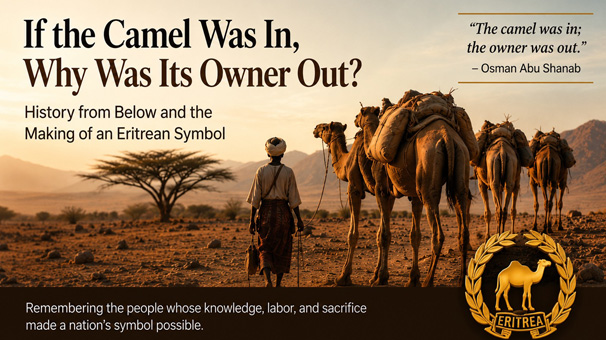

In memory of the late freedom fighter Osman Abu Shanab, whose words and spirit continue to be remembered: “The camel was in; the owner was out.”
I would like to begin by thanking my fellow Awate author, Ismail, for the thoughtful response he offered to an earlier discussion. His response brought me back to a brief but powerful statement attributed to the late Osman Abu Shanab: “The camel was in; the owner was out.” The sentence stayed with me because it seemed to contain a much larger question. The camel is visible in Eritrea’s national imagery, but what about the people who owned it, herded it, cared for it, depended upon it, and made its usefulness possible? That question opens a different way of looking at Eritrean history, not only through political organizations, military leaders, battles, and diplomacy, but also through the material lives of ordinary people.
Across Eritrea and the wider African and Sahelian regions, the camel has long been an animal of extraordinary practical value. In arid and semi-arid environments, its ability to survive with limited water, travel long distances, and carry heavy loads has made it central to pastoral economies and rural mobility. In Eritrea, camels have historically been concentrated, especially in the eastern and western lowlands. They have been used for riding, transport, ploughing, carrying firewood and water, moving trade goods, and supporting seasonal migration. For pastoral families, the camel could provide milk and meat as well as transport and economic security. This was not simply an animal economy; it was a way of organizing life.
A camel could carry a household’s belongings during migration, transport water from a distant source, bring firewood from the countryside, or move goods toward a market. It could carry the sick, the elderly, or children. In communities where roads and motorized transportation were limited, the animal was part of the infrastructure of everyday survival. Behind every camel, however, was a human relationship: someone who owned it, bred it, trained it, herded it, watered it, treated it, and knew how to glide and move with it through difficult terrain. That is where the owner begins to come into view.
The camel also occupied a place beyond purely economic activity. Livestock ownership could be connected to family wealth, social obligations, inheritance, marriage, compensation, and community relationships. Among Eritrean pastoral communities, the camel could be part of the social fabric itself. The Blin experience offers another illustration. Among the Blin of central Eritrea, marriage has historically been a major community institution involving families, elders, obligations, and traditions. In oral accounts of Blin custom, the camel has also been associated with marriage and the movement of the bride from her family home toward that of the bridegroom. Whether one looks at the camel through transport, wealth, migration, marriage, or family life, the same point emerges: it was embedded in human relationships. The camel carried more than goods; it carried a way of life.
This becomes even more significant when we consider Eritrea’s armed struggle for independence. The history of the struggle is usually told through organizations, commanders, battles, political disagreements, diplomatic efforts, and the sacrifices of fighters and civilians. These are indispensable parts of the story, but every armed movement also depends upon a less visible world of logistics. Food has to move, water has to move, and ammunition, medicine, firewood, clothing, equipment, and people have to move. In difficult terrain, transportation can determine what is possible. The Eritrean Liberation Front emerged in the western lowlands, while the Eritrean People’s Liberation Front operated across extensive and difficult areas, including the Sahel. In such environments, animals were not incidental; they were part of the practical system that allowed people and supplies to move.
Donate
The camel’s wartime role is particularly significant. Camels were used to transport supplies and people over long distances and through terrain where motorized transportation was difficult or impossible. They were part of the logistical system that sustained communities and fighters operating in remote areas. The camel therefore carried part of the physical burden of the struggle, but it did not carry that burden alone. Someone had to own the camel, someone had to bring it, someone had to train it, someone had to know the routes, someone had to feed and water it, someone had to risk losing it, and someone had to live with the consequences when the animal did not return. This is the part of the story that can disappear when history is written primarily through institutions and military organizations.
After independence, the camel moved from the landscape of everyday life into the official imagery of the nation. Eritrea adopted its national emblem on May 24, 1993. At its center is a dromedary camel surrounded by an olive wreath. The camel’s presence in the emblem has been explained in connection with its role in transporting supplies and goods during the independence struggle and with its broader importance in Eritrean life. The symbolism is easy to understand: the camel suggests endurance, resilience, mobility, self-reliance, and the ability to survive in harsh conditions. The camel became a national symbol because people had already made it useful.
But the transformation creates a question: what happens when the symbol survives more visibly than the people who gave it meaning? This is where Osman Abu Shanab’s sentence becomes more than an observation about an animal: “The camel was in; the owner was out.” The camel entered the national story. Its image entered the emblem. Its endurance became a metaphor for the nation. Its wartime service became part of the story of independence. But the people behind it can remain largely invisible.
The pastoralist who owned the camel does not appear on the emblem. The young man who herded it does not appear on the emblem. The woman who helped sustain the household and the animals does not appear on the emblem. The family whose livestock represented wealth, mobility, and survival does not appear on the emblem. The rural community whose knowledge made movement through difficult terrain possible does not appear on the emblem. The camel is visible. The owner disappears.
That is the paradox, and it is also a problem of how national history is remembered. History from above naturally gives attention to states, governments, political organizations, armies, leaders, institutions, and major events. History from below asks different questions: who carried the supplies, who knew where the water was, who moved goods through difficult terrain, who maintained livestock, who provided food, who kept households functioning while men were away, and who performed essential work without becoming part of the official narrative? These questions do not diminish the achievements or sacrifices of fighters; they enlarge the story.
An armed struggle is not sustained by combatants alone. It rests upon networks of people, labor, knowledge, resources, and movement. The camel was one part of that network; its owner was another. But the power of Abu Shanab’s statement does not depend on proving that this was his precise political intention. Its power lies in the question it allows us to ask: who gets represented by the national symbol, and who gets represented only indirectly through it? When we say that the camel represents Eritrean endurance, we should also ask whose endurance we are talking about. When we celebrate its resilience, whose resilience are we remembering? A national symbol does not arrive in history by itself. Behind it are people, relationships, knowledge, labor, sacrifice, and lives. The camel did not become a symbol because it was merely picturesque; it became a symbol because people had already made it useful. Osman Abu Shanab left us the question in six words: “The camel was in; the owner was out.” History from below asks us to bring the owner back in.
Video reference: the following video provides a visual reference to the relationship between an Eritrean community and the camel: https://www.youtube.com/watch?v=0hlijp8uLhU