
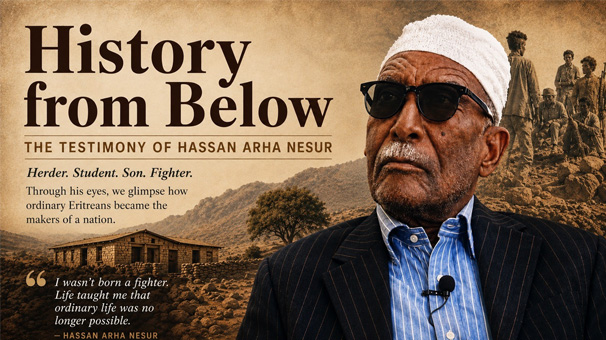

History is often written from above. We remember emperors, presidents, commanders, declarations, treaties, and battles. Nations appear to emerge through the decisions of remarkable individuals whose names become inseparable from the histories they helped shape.
Yet nations are rarely built from above alone. They are also built quietly, almost imperceptibly, in the lives of ordinary people whose names seldom appear in history books. A shepherd. A student. A mother. A teacher. A laborer. A village elder. Before they become participants in history, they are simply people trying to live ordinary lives.
Listening to the late Hassan Arha Nesur, I realized that I was not merely listening to a veteran of Eritrea’s liberation struggle. I was listening to the slow making of a citizen. That distinction matters. Too often we approach veterans carrying today’s political questions. We ask them to defend or condemn later events before we have fully entered the historical world they inhabited. Yesterday’s memories become cross-examined by today’s disappointments. But memory deserves its own chronology.
To understand his testimony, we must first allow him to remain where he was. He belonged to a generation whose childhood unfolded during the decade of the Eritrea-Ethiopia Federation established under United Nations General Assembly Resolution 390 A (V) of December 2, 1950. Eritrea possessed its own constitution, parliament, judiciary, and flag, which flew beside Ethiopia’s. It was an imperfect arrangement, but it gave constitutional form to an Eritrean political identity before that identity was gradually dismantled. He therefore witnessed not only oppression. He witnessed its arrival. That distinction matters.
History entered the village long before it entered the battlefield. Before he carried a rifle, he carried responsibility. He was a herder. His world was measured by seasons rather than ideology, by livestock rather than politics. Nothing in his early life suggested that history would eventually claim him. Then history entered the village. It did not arrive first through soldiers. It arrived through schools.
He recalled how the existing educational system was dismantled. Books were collected. A new curriculum would replace the old one under imperial authority. On paper, this could appear to be an administrative reform. For those living through it, it was something else entirely. Schools do more than teach reading and arithmetic. They quietly tell children whose history matters. Whose language matters. Whose future matters. Sometimes the most political decisions are made inside classrooms. For many young Eritreans, education became the first place where power announced itself not as an abstract institution but as an intimate presence capable of reshaping everyday life.
Donate
History had entered the village. He did not describe this moment as an ideological awakening. He simply described what he saw. That is precisely what gives his testimony its force.
Political consciousness rarely arrives as a single revelation. More often it accumulates quietly. One decree. One conversation. One humiliation. One observation. Life itself becomes the teacher. History entered the village one ordinary day at a time.
There came a time when he left for Sudan. Like countless young Eritreans, he sought work rather than revolution. He earned money and sent it home to support his family. His mother tried to reassure him. “There is no list,” she insisted. “The Ethiopian authorities are not looking for you.” Her words were more than reassurance. They were an invitation back to ordinary life. Come home. Work. Help the family. Survive.
But history is not always persuaded by ordinary life. Something had already changed within him. He could no longer unknow what he had seen. No political cadre needed to convince him. Experience had already done that.
That, perhaps, is one of the deepest lessons contained in this testimony. People do not always enter history because someone recruits them. Sometimes they enter because experience itself has recruited them. History had entered the village first. Now it followed him across a border.
When the time came to join the liberation front, another remarkable episode occurred.
New recruits were to undergo medical examinations before being admitted. Then circumstances intervened. A commander urgently needed fighters. The examinations were postponed. The young recruits entered the field immediately.
This might appear to be a minor anecdote. It is anything but. Looking backward, history often seems inevitable. Battles seem destined. Movements seem unstoppable. Lives appear to unfold according to grand historical forces. Yet this recollection quietly reminds us that history also turns on contingency. A delayed medical examination. An urgent military need. A decision made in a single day.
Thus, history is shaped not only by great ideas but also by ordinary moments whose significance becomes visible only decades later.
Listening to his recollections, I found myself thinking less about famous leaders than about ordinary people. Modern political debates often struggle to separate different historical moments. When he speaks respectfully about commanders he encountered during the liberation struggle, some listeners immediately hear an argument about later decades. Yet that was not what he was offering. He was remembering the world as he experienced it then.
History requires us to respect chronology before rendering judgment. The young commander remembered in the field and the president remembered after independence belong to different historical moments, even though they are the same individual. To acknowledge one historical reality does not erase another. Nor does later history invalidate earlier experience.
Good history asks us to inhabit each moment before we evaluate it. That is more difficult than choosing sides. It is also more faithful to the lives people actually lived.
His testimony leaves us with something more valuable than political conclusions. It leaves us with a human story. Not the story of ideology. The story of becoming. A shepherd became a fighter. A son became a witness. An ordinary citizen gradually discovered that the world around him had changed in ways that made ordinary life impossible.
Every nation eventually constructs monuments. It records battles. It celebrates victories. It remembers commanders. Those acts of remembrance are important. But beneath every monument lies another foundation. It is built from ordinary lives. Lives that history seldom pauses long enough to hear.
This testimony belongs to that quieter foundation. Through it we see that Eritrea was not built only by military strategy or political leadership. It was built by countless ordinary Eritreans whose moral worlds changed before their political actions did. That may be the most enduring lesson his life leaves behind.
Before there was an independent Eritrean state, there were Eritreans who made nationhood imaginable through the choices they made, the burdens they carried, and the worlds they found no longer possible to inhabit. Before history passed judgment, there was simply a young shepherd trying to understand the world into which he had been born.