
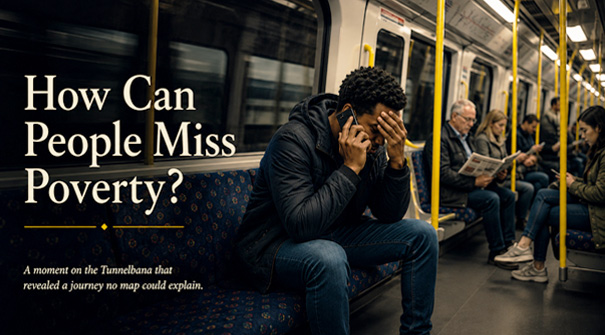

When a Better Life Becomes a Different Kind of Responsibility
The carriage lurched gently as it slipped into another tunnel beneath Stockholm. Outside the windows there was nothing to see but darkness interrupted by brief flashes of platform lights. Inside, however, every seat held a destination, every face a private history.
Some passengers scrolled absentmindedly through their phones. Others leaned their heads against the glass, surrendering to the fatigue of another working day. A young woman sat near the window, her thumb moving across her screen with practiced rhythm. Across from her, an elderly man folded his newspaper carefully before returning it to his briefcase. A child, too tired to protest the day’s adventures, rested his head against his mother’s shoulder. Around them sat dozens of commuters sharing the same carriage while remaining almost entirely unknown to one another. It was the kind of ordinary afternoon that rarely asks to be remembered.
Then I heard a familiar language. It was not loud. It did not disturb the quiet discipline of the carriage. But hearing one of Eritrea’s languages beneath the streets of Stockholm immediately rearranged my attention. Thousands of kilometers from one’s country of origin, a familiar language has a way of collapsing distance. For a moment, strangers become neighbors. The voice belonged to a young man sitting a few seats away. He appeared to be around thirty years old. His jacket was worn, his face tired, and his posture carried the heaviness of someone nearing the end of a long day. He spoke softly into his phone.
At first, I tried not to listen. The conversation was not intended for me. Yet, little by little, fragments reached me, and those fragments became difficult to ignore. A border. A journey. Work. Money. His mother. His father. Slowly, the fragments assembled themselves into a life.
His words carried the exhaustion of someone who had lived several lives before reaching thirty. He spoke of leaving Eritrea, enduring difficult conditions in another country, travelling through southern Europe, and eventually arriving in Scandinavia. There was no drama in the way he recounted these events. Only the quiet matter-of-factness of someone describing experiences he no longer expected anyone to find extraordinary.
Donate
Migration is often described through statistics: numbers of arrivals, asylum applications, residency permits, employment rates, and financial transfers. But every statistic contains a life that cannot be fully measured. Behind each number is someone who feared, waited, crossed, lost, endured, and continued. The young man eventually reached Sweden hoping to begin again. Beginning again required more than geographical arrival. He had to navigate the asylum process, learn a new language, understand unfamiliar institutions, and create stability in a society very different from the one he had left behind. Slowly, he succeeded. He received permanent residency. He found employment. He established a routine.
From the outside, his journey might have appeared complete. He had crossed the border between uncertainty and security. He had reached the place that migration stories frequently identify as their destination. Yet the story emerging inside the carriage was no longer about how he reached Sweden. It was about everything that followed after he arrived. He had found work. More than one job, from the sound of it. Long days had become ordinary. Weekends were no longer measured by rest but by overtime. Every additional shift meant another transfer of money to the people waiting for him on the other side of the world. He was not working only to pay his own rent or build his own future. His income had become connected to the survival and hopes of others.
This responsibility is familiar within Eritrean and many other diaspora communities. Migration may relocate the body, but it does not dissolve family obligations. A person may live physically in Stockholm while remaining emotionally and financially present in Asmara, Keren, Massawa, or a distant rural village. Home continues to travel with the migrant.
It arrives through telephone calls, requests for assistance, medical emergencies, school expenses, weddings, funerals, household needs, and decisions that must be made across continents. Remittances are therefore never merely financial transactions. They may carry love, loyalty, duty, guilt, hope, and the continuing desire to remain part of the family one has physically left behind.
The young man’s voice, steady until then, began to grow heavier. From scattered sentences, I gathered that he had saved for years to build his parents a modern house in an urban area of Eritrea. It was the kind of gift many sons and daughters dream of giving but few ever achieve. To him, the house represented far more than walls and a roof. It was labor made visible. It was a sacrifice given a physical form. It was his way of thanking his parents and assuring himself that the difficult journey he had endured had produced something meaningful.
Perhaps he imagined them waking each morning in greater comfort. Perhaps he pictured electricity replacing darkness, running water easing daily labor, and city life bringing them closer to services unavailable in the countryside. He believed he was offering them dignity, security, and relief after years of hardship. When the house was completed, he asked his parents to leave their village and move into the city. They agreed. For a time, he must have believed that he had fulfilled one of his greatest responsibilities as a son.
But gradually, the telephone calls changed. His parents began mentioning expenses he had not anticipated. Electricity bills became a source of worry. Water shortages disrupted their routines. Charcoal, once easily obtained, now had to be purchased. The house required money simply to remain livable. What he regarded as comfort introduced new forms of dependence. What he understood as progress created unfamiliar burdens. The parents began speaking longingly about the village they had left behind. At first, the young man could not understand them. How could they miss the place he had worked so hard to help them leave? How could they prefer a life of fewer conveniences after he had sacrificed so much to provide something better?
From his perspective, the new house represented a movement forward. It represented improvement, success, and the fulfillment of an obligation. But his parents were measuring life through a different set of values. For them, the village was not merely a place of hardship. It was a place of memory and belonging. Their neighbors knew them. Their routines had been shaped over a lifetime. They understood the land, the paths, the seasons, and the expectations of the community around them. Their previous life may have contained material scarcity, but it also contained familiarity. The new house offered modern walls, but it could not immediately reproduce the relationships that had made the old place home.
A better life is not always defined in the same way by those who give it and those expected to receive it. For one generation, improvement may mean modern housing, electricity, urban services, and greater access to opportunity. For another, well-being may be found in continuity, community, simplicity, and the confidence of knowing where one belongs. Neither understanding is necessarily false. The tragedy begins when each side assumes its own definition of a better life must also be the other’s.
The disagreement between the young man’s parents deepened. His father wanted to return to the countryside. His mother preferred to remain in the city. A house intended to bring comfort had become a source of conflict between them. The son found himself trapped between two worlds. He had worked to create a future for his parents, but the future he imagined did not resemble the life they wanted. Their unhappiness felt to him like a rejection not only of the house but also of every exhausting shift, every postponed pleasure, and every sacrifice that had made the house possible.
Inside the Tunnelbana carriage, ordinary life continued. A passenger listened to music through headphones. Someone turned the page of a book. The child who had been resting against his mother briefly opened his eyes before closing them again. At each station, some passengers departed and others took their places. No one seemed aware that, only a few seats away, a young man’s understanding of love was beginning to collapse. His voice became quiet. He stopped explaining. He stopped defending his intentions. Then came the sentence that changed everything. One of his parents had asked him, “What have you ever done for us besides creating more problems?”
Silence followed. Not the silence of a dropped telephone connection. The silence of a son searching for words that no longer existed. He covered his face with one hand. Whether he was trying to hide his tears or simply gather himself was not clear from my vantage point. The pain was no longer about the house alone. It was no longer about electricity, water, charcoal, or money. It was about feeling unseen. After years of working, sending, saving, and sacrificing, he believed that the love behind his actions had been misunderstood.
The train reached another station. The young man rose slowly and stepped onto the platform. The doors began to close. For a moment, he remained visible through the window before turning toward the escalator. Then, almost as if speaking to himself rather than to anyone else, he uttered the words that stayed with me long after he disappeared into the crowd:
“How can people miss poverty?”
The train pulled away. Within seconds, another passenger occupied the empty seat. The conversation had ended. The question had not. I had become so absorbed in his story that I had missed my own stop. Yet even after I changed trains and began the journey back, his question traveled with me. How could people miss poverty? The more I considered it, the more I wondered whether the question had been asked correctly. It is entirely conceivable that people do not miss poverty itself—that they miss the world that existed around it. A neighbor who entered without knocking. Evenings spent beneath familiar trees. The confidence of knowing every path through the village without needing directions.
Conversations that required neither appointments nor telephone calls. The daily routines through which one’s life became recognizable and meaningful. The quiet assurance that one belonged exactly where one was. Poverty is rarely remembered in isolation. Memory gathers other things around it: relationships, traditions, habits, identities, and the emotional geography of home. Material hardship and emotional belonging do not always occupy opposite ends of the same road. Sometimes they live side by side. That is one of migration’s deepest paradoxes.
Migrants often leave because the life available to them has become difficult, unsafe, or impossible. Yet departure does not sever their connection to the people and places left behind. Success abroad may even intensify that connection. The more migrants achieve, the greater the expectations placed upon them. Their personal progress gradually becomes a family resource.
Remittances can feed households, educate children, pay for medical care, and provide shelter. They can transform lives. But they may also create dependencies, disagreements, and responsibilities that no individual can satisfy indefinitely. Behind every transfer of money is a person working within one economy while being held accountable by the needs of another. Behind every newly built house may be a migrant who postponed rest, education, marriage, parenthood, or personal ambition. And behind every act of generosity may be an expectation that love will be recognized in precisely the form in which it was given.
But love is not always received according to the intentions of the giver. A son may build a new house, but he cannot rebuild another person’s memories. He may improve material conditions yet remain powerless before the invisible architecture of attachment that binds people to places, routines, and communities. He may send money, but he cannot transfer belonging. He may provide opportunity, but he cannot decide what another person considers a meaningful life. Love can build walls, lay foundations, and replace leaking roofs. What it cannot always do is transport a lifetime of belonging from one place to another.
As the train emerged from the final tunnel and daylight returned to the windows, Stockholm looked unchanged. Passengers continued toward their destinations. The platforms filled and emptied. Another ordinary afternoon moved quietly toward evening. But the journey had become different. The young man had left the carriage carrying his disappointment. He had left his question behind. The greatest challenge for many migrants is not only leaving home. It is discovering that, no matter how far they travel, they may spend the rest of their lives trying to carry home with them.