
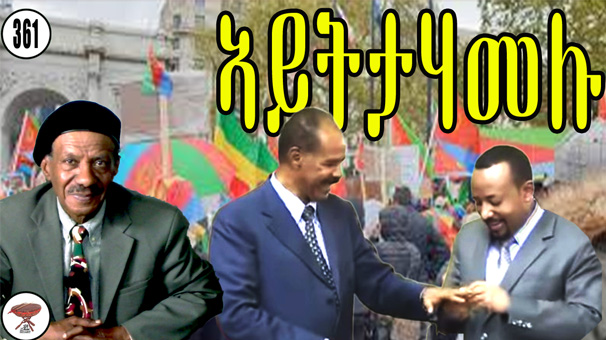

One of the major grievances Isaias Afwerki frequently expresses is his disdain for the ethnic-based political system the TPLF—his on-and-off ally—instituted in Ethiopia. He presents himself as morally appalled by ethnic federalism. Yet this posture obscures an inconvenient truth: Isaias was an equal stakeholder in the regional hegemony jointly exercised by the EPLF and the TPLF for decades.
From the beginning, the relationship between the two liberation fronts was unpredictable and fraught with unresolved contradictions. While the TPLF gravitated toward a form of participatory governance—however uneven, selective, and ethnically skewed—the PFDJ showed no interest in power sharing of any kind. Rule of law, constitutionalism, parliament, elections, or even limited freedom of expression were dismissed as luxuries Eritrea could not afford. In practice, both movements remained loyal to the centralized, command-style governance they had mastered during the armed struggle.
In the first year after 1991, when both fronts assumed power in Ethiopia and Eritrea, respectively, their relationship was cautious, opaque, and deliberately secretive. Few observers could clearly identify the source of tension between the two regimes. Disagreements were whispered about but never articulated publicly. It was not until the death of Meles Zenawi in 2012 that fragments of the truth began to surface.
After Meles’s death, long-guarded secrets emerged in carefully measured doses. PFDJ defectors began to speak out following the arrest of the G15, though their disclosures were constrained and often filtered. Over time, Eritrean independent media played a significant role in exposing the inner workings of the otherwise impenetrable PFDJ leadership. The TPLF, on the other hand, remained largely silent for years—nearly as guarded as the imprisoned G15—until it went into full disclosure mode after the outbreak of the 2020 Ethiopian civil war.
For many years, few knew that Isaias Afwerki had once been offered a role to lead the two countries under a loosely defined federation or confederation. This astonishing detail only became public after relations between the former allies deteriorated beyond repair.
During the 1990s, friction initially centered on economic interests rather than ideology. Well into the mid-nineties, both movements behaved as occupiers of foreign territory rather than accountable governments. TPLF cadres routinely referred to Ethiopia in the third person—“their country”—as though it were a recently liberated colony. The EPLF, meanwhile, acted as the sole proprietor of Eritrea while simultaneously positioning itself as a stakeholder in the Ethiopian economy. Many veterans of the armed struggle found themselves treated worse than the defeated enemy forces they had fought against.
Donate
These tensions surfaced openly in the early 1990s. The TPLF began regulating Ethiopian products entering Eritrea—down to a kilogram of coffee requiring customs clearance. In Addis Ababa, deported Ethiopians, many of them expelled from Assab, staged daily demonstrations. Propaganda flourished. One particularly absurd claim alleged that all Ambessa city buses had been transferred to Eritrea, causing Addis Ababa’s transportation crisis. This writer had just arrived from Asmara at the time, where transportation shortages were far worse—without a single Ambessa bus in sight. What was undeniable, however, was that border towns such as Zalambessa were flooded with deported Ethiopians: wives of soldiers, bar workers, and prostitutes who had catered to an overwhelmingly single army. Conditions deteriorated rapidly under the noses of two allied regimes too self-assured to grasp the looming danger.
Around 1994, EFFORT—the TPLF’s powerful economic arm—opened Wegagen Bank in Addis Ababa and other cities. Addis Ababa was treated like a jointly liberated, foreign-occupied capital. In response, the EPLF launched Horn Bank, initiating a competitive scramble for control of Ethiopia’s economic landscape. From there, relations entered a downward freefall.
Ethiopia soon announced that all exports to Eritrea, including cross-border trade, would be conducted exclusively through letters of credit—an alien concept in a region accustomed to informal commerce. The Assab transit trade suffered greatly, and Ethiopia shifted decisively toward Djibouti. Matters worsened with the introduction of Nakfa, Eritrea’s new currency. Propaganda poisoned relations between ordinary people. One particularly toxic claim declared that the Nakfa was unfit for alms or church offerings because the banknote depicted Muslim girls. This may have been the most lethal piece of propaganda unleashed by bigots. Relations between the two societies reached an irreparable breaking point.
Armed border guards were on constant edge. Instead of resolving disputes through diplomacy, soldiers reverted to what they knew best. Eritrean soldiers were killed, triggering the devastating border war. Tens of thousands died. Hundreds of thousands were displaced. The rulers of both countries failed catastrophically to contain the violence.
The war fought between 1998 and 2000 officially ended hostilities. The International Court of Arbitration issued its ruling, but the border was never demarcated. The conflict was left to simmer beneath the surface, poisoning relations for years.
In 2018, Abiy Ahmed assumed power and, together with Isaias Afwerki, signed a highly publicized peace agreement in Asmara—later echoed in Abu Dhabi and Jeddah. Contrary to the surrounding propaganda, the agreement produced no tangible outcomes. Its most concrete result was paving the way for Abiy Ahmed’s Nobel Peace Prize. Two years later, the emptiness of that peace was laid bare when another devastating war erupted, leaving the region worse off than before.
This time, the war involved multiple actors: Ethiopian federal forces, Eritrean defense forces, Amhara militias and affiliated groups, rebels from Gojjam and Oromia, and Afar regional forces.
That, in brief, is the backdrop to the Badme War and the conflicts culminating in 2022.
Today, Abiy Ahmed appears to have sown sufficient confusion and inflamed his base. He seems to believe that perpetual war rhetoric—particularly threats over Assab—can intimidate and demoralize Eritreans indefinitely. Yet after five years of such posturing, one must ask: what has been achieved?
Eritreans continue to resist both internal repression and external aggression. Many view the two systems as inseparable conspirators, united in delaying emancipation and keeping the region permanently on edge—guns raised, blood spilled as ritual. The region will not advance an inch unless it confronts the pathology of leaders who seem incapable of governing without sacrificing tens of thousands of young lives in recurring cycles of destruction.
In the following Negarit, I will offer a bird’s-eye view of what may have slowed Abiy Ahmed’s obsession and examine developments among Arab neighbors and other regional factors shaping the shifting dynamics of war and peace.